Manual vs Automated Trading: Which Approach Wins?
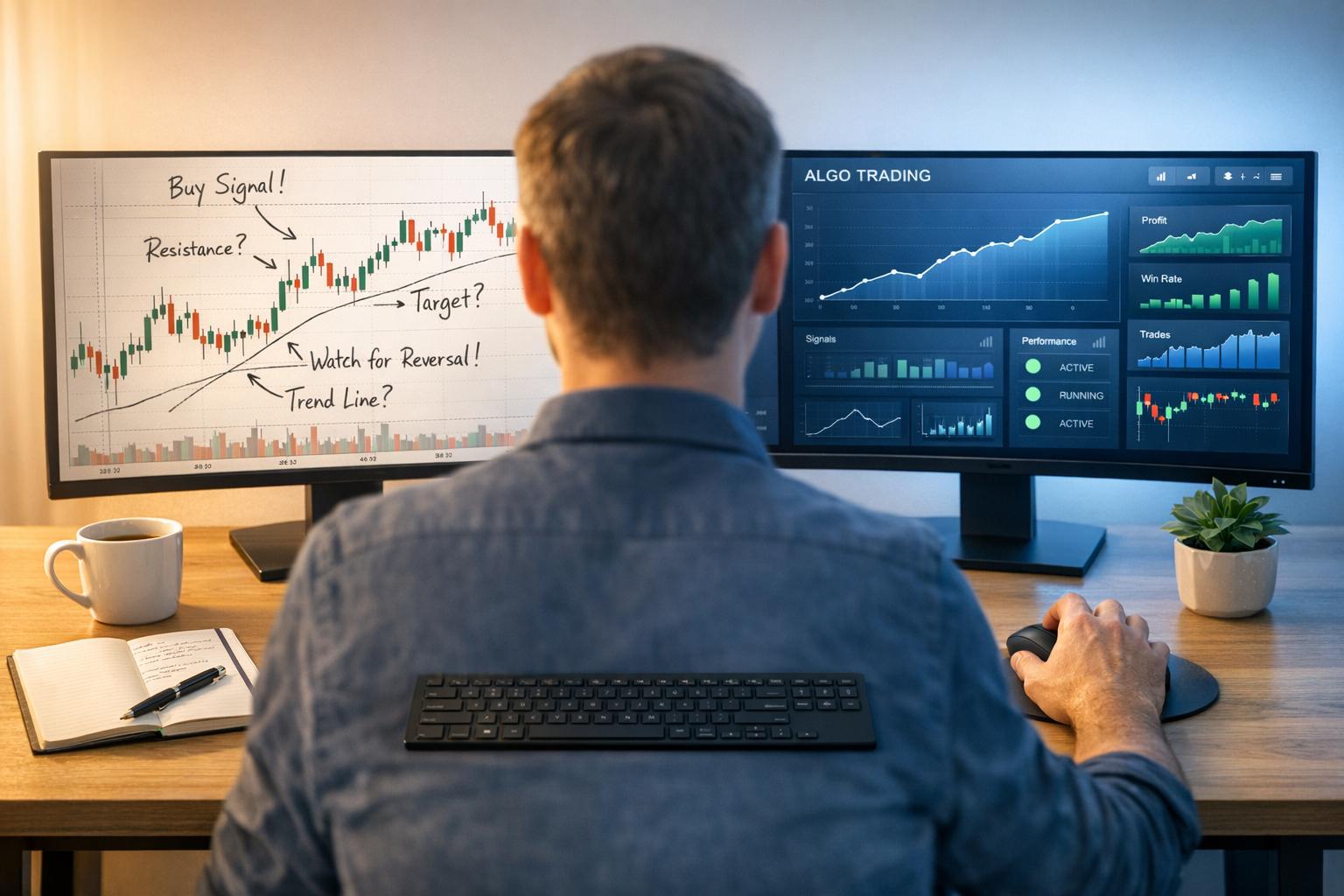
Manual vs Automated Trading: Which Approach Wins?
Wondering whether manual or automated trading is the better choice? Here’s the short answer:
- Manual trading relies on human judgment, offering flexibility and control to react to unexpected market events. However, it demands significant time, focus, and emotional discipline.
- Automated trading uses algorithms to execute predefined rules, ensuring speed, consistency, and 24/7 operation. It removes emotional biases but struggles with unforeseen scenarios and requires technical oversight.
Key Takeaways:
- Manual Trading: Best for traders who value control and can analyze qualitative factors like news or economic events. Time-intensive and prone to emotional errors.
- Automated Trading: Ideal for those prioritizing efficiency, speed, and consistency. Works well for rule-based strategies but lacks adaptability to unique situations.
Quick Comparison:
| Feature | Manual Trading | Automated Trading |
|---|---|---|
| Control | High, flexible to market changes | Low, follows strict rules |
| Emotional Influence | Prone to fear and greed | Eliminates emotional decision-making |
| Speed | Slower, takes seconds to execute | Instant, trades in milliseconds |
| Time Investment | High, requires constant attention | Low, runs 24/7 with minimal monitoring |
| Scalability | Limited to a few markets | Monitors multiple markets simultaneously |
| Risk of Errors | Human errors, e.g., "fat-finger" mistakes | Technical issues like software glitches |
Blending both approaches can offer the best of both worlds: use automation for repetitive tasks and manual intervention for critical decisions. Your choice depends on your goals, time availability, and trading style.
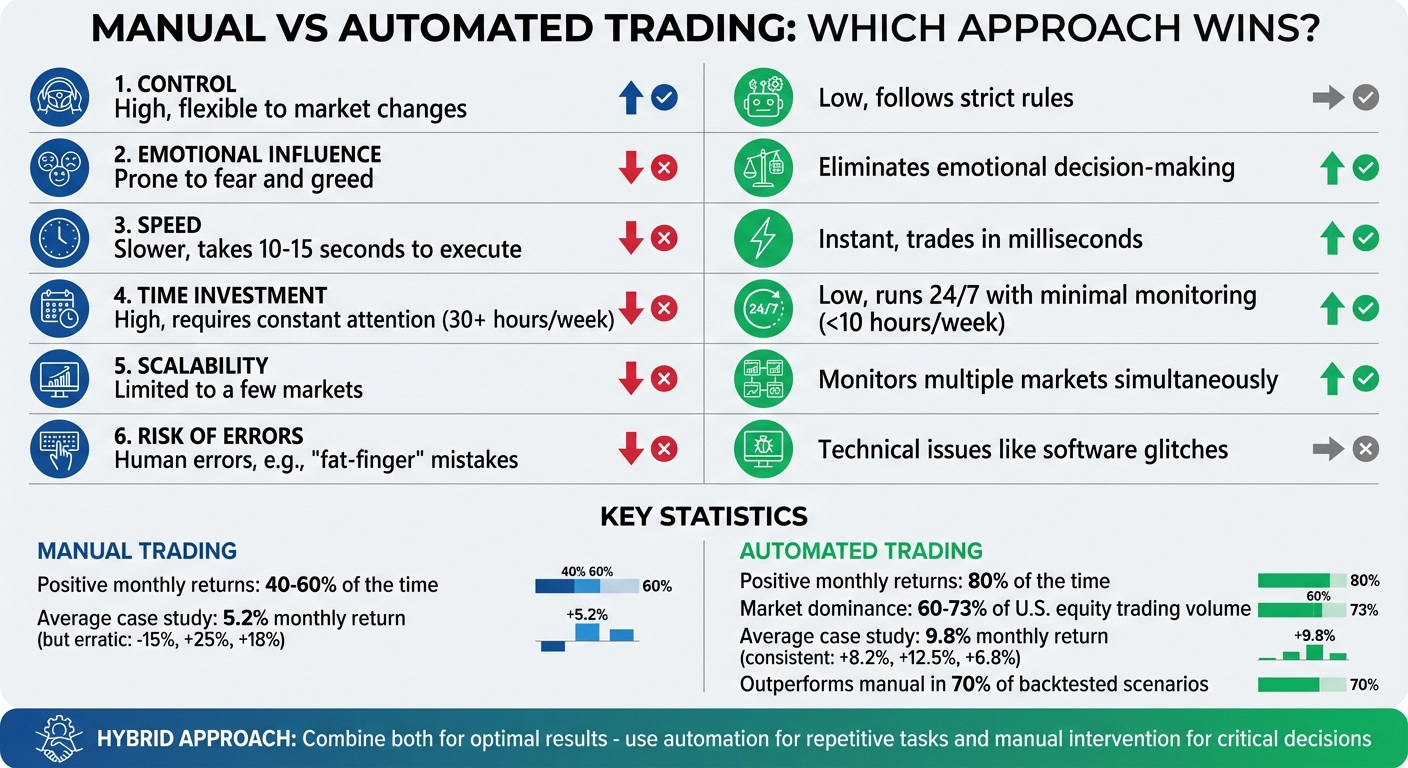
Manual vs Automated Trading: Complete Feature Comparison
Manual VS Automated Trading. Which is better?
sbb-itb-3b27815
What is Manual Trading?
Manual trading is all about human judgment. Instead of relying on algorithms, traders analyze market data themselves and make decisions based on their observations. Think of it like driving your own car - every move is under your control.
Let’s look at how manual traders approach the markets step by step.
How Manual Trading Works
The process begins before the market even opens. Traders dive into charts, news updates, and economic calendars to prepare for the day ahead. They identify potential setups, calculate position sizes, and manually place orders when the time is right. For instance, if a golden crossover appears on a moving average chart, a trader would determine the position size, set a stop-loss, and execute the trade directly through their platform.
This method requires constant attention. You’ll need to monitor price movements closely, ready to act as opportunities arise or conditions shift unexpectedly. Unlike automated systems that run 24/7, manual trading demands your active involvement. It’s a hands-on process where you’re in the driver’s seat, adjusting strategies in real time to keep up with the market.
This active participation highlights the adaptability and precision that manual trading can offer, which we’ll explore further.
Main Characteristics of Manual Trading
What sets manual trading apart is its ability to adapt to the unexpected. As BabyPips explains:
"Manual trading offers flexibility and discretion. A human trader can weigh qualitative factors, such as a central bank speech, political developments, or unexpected headlines, that a bot may ignore."
This means manual traders can respond to events that automated systems might overlook. Whether it’s a surprise merger, a natural disaster impacting commodity prices, or subtle shifts like declining trading volume, human traders can interpret these nuances and adjust their approach accordingly. Experience, intuition, and the ability to "read between the lines" give manual traders an edge in situations that fall outside rigid algorithms.
But this human touch isn’t without its challenges. Emotional factors like fear and greed can cloud judgment, and physical limitations - like fatigue or slower reaction times - can hinder performance. Additionally, manual traders can only focus on a limited number of instruments at a time, unlike automated systems that process multiple markets simultaneously.
What is Automated Trading?
Automated trading replaces the need for manual intervention in monitoring markets and executing trades. These systems, often referred to as Expert Advisors (EAs) in the MQL5 ecosystem, operate by following a set of predefined rules encoded into algorithms. For instance, if a condition like a moving average crossover or an RSI signal is met, the system executes trades instantly - no need for human confirmation.
The reach of automated trading is impressive. It now accounts for around 60–73% of all U.S. equity trading volume. These systems dominate global financial markets, showcasing how widely algorithmic trading has been embraced. Compare this to manual trading, where it may take 10–15 seconds to analyze and execute an order - automated systems complete the same task in milliseconds.
Platforms such as Traidies have made automation accessible even to those without coding expertise. With Traidies, you can simply describe your strategy in plain English - something like, "Buy when the 50-day moving average crosses above the 200-day, with a 2% stop-loss" - and the platform generates the corresponding MQL5 code. Before committing real money, you can backtest the strategy using historical data to analyze performance metrics like win rate and drawdown.
How Automated Trading Works
The process starts by defining your trading strategy as a series of "if-then" rules. These rules specify when to enter, exit, or manage risk. The logic is then converted into MQL5 code, either manually or with the help of AI-driven tools like Traidies.
Once the system is up and running, it continuously scans live market data, analyzing price movements, technical indicators, and volume patterns across multiple instruments. When the set conditions are met, the algorithm executes orders instantly - no hesitation or second-guessing. Unlike manual traders, who might miss opportunities during breaks or moments of indecision, automated systems work around the clock.
This constant, rule-based operation forms the backbone of automated trading’s benefits.
Main Characteristics of Automated Trading
One standout feature of automated trading is its ability to execute trades without emotional interference. As Investopedia highlights:
"One of the biggest attractions of strategy automation is that it can take some of the emotion out of trading since trades are automatically placed once certain criteria are met."
By removing emotions like fear and greed, automated systems stick strictly to the predefined rules, regardless of market conditions. This discipline helps traders avoid common pitfalls like "revenge trading" or abandoning a sound plan during a losing streak. By eliminating human delays and biases, automation addresses many of the challenges that come with manual trading.
Speed and scalability are other key advantages. Algorithms can simultaneously monitor and analyze dozens of markets or currency pairs - a feat that would overwhelm any manual trader. Research from the MQL5 community shows that automated systems outperform manual trading in roughly 70% of backtested scenarios.
Platforms like Traidies simplify the technical aspects by offering automated backtesting. After generating the MQL5 code, the platform tests it against historical data to confirm its profitability and assess risk. You can also fine-tune parameters, such as RSI periods or moving average lengths, and use techniques like out-of-sample testing to ensure the strategy adapts to changing market conditions. Understanding these features helps traders decide when automation provides the most value - a topic we’ll dive into when comparing automated and manual approaches.
Strengths and Weaknesses of Each Approach
Both manual and automated trading come with their own pros and cons, influencing factors like performance, time investment, and stress levels. Understanding these differences can help you align the right approach with your goals and lifestyle.
Manual Trading: Advantages and Disadvantages
Manual trading offers a hands-on approach, which comes with both benefits and challenges.
One of its biggest strengths is the control it provides. You’re in charge of every decision, allowing you to respond quickly to unexpected market events - whether it’s a Federal Reserve announcement, geopolitical turmoil, or a surprise corporate merger that an algorithm might not recognize. Your personal experience and intuition play a critical role in navigating situations that don’t fit neatly into pre-set rules.
But this level of control has its downsides. Emotional factors like fear and greed can easily derail your strategy. Studies show that manual traders achieve positive monthly returns only 40–60% of the time, compared to 80% for automated systems. Even experienced traders can face "trading fatigue", where constant monitoring erodes their ability to stick to their own rules.
| Advantages | Disadvantages |
|---|---|
| Quick adaptation to volatile markets | Highly prone to emotional biases, including fear and greed |
| Full control and intuitive decision-making | Time-intensive; requires constant focus |
| Ability to assess qualitative factors and context | Risk of human errors like "fat-finger" mistakes |
| No reliance on technology or connectivity | Susceptible to trading fatigue over time |
Take Mike, for example, a full-time manual trader. In 2024, he spent 40 hours a week trading EUR/USD and GBP/USD. His results over three months were erratic: -15% in the first month, +25% in the second, and +18% in the third. While he averaged a 5.2% monthly return, it highlights the challenges even skilled traders face.
Automated Trading: Advantages and Disadvantages
Automated trading, on the other hand, offers a systematic, rule-based approach.
One major advantage is its ability to remove emotions from the equation. As Alexander Horn, Head of Automated Strategies at Advanced AutoTrades, puts it:
"Success in trading isn't about predicting the future - it's about building systems that handle uncertainty with discipline and consistency."
Automated systems dominate U.S. equity markets, accounting for 60–73% of trading volume and managing around $4 trillion in daily transactions [4, 16]. These systems execute trades in milliseconds (compared to 10–15 seconds manually) and operate 24/7 across multiple markets. With proper risk management, they can deliver average annual returns of 15–40%.
Consider Sarah, an IT professional who used the TrendCatch Pro EA to trade five major currency pairs in 2024. Over six months, she achieved an average monthly return of 9.8%, with individual months showing +8.2%, +12.5%, and +6.8%. She only spent two hours per week monitoring, illustrating the efficiency of automation.
| Advantages | Disadvantages |
|---|---|
| Eliminates emotional decision-making | Limited flexibility; cannot adapt to unprogrammed events |
| Executes trades in milliseconds | Vulnerable to technical issues like power outages or software glitches |
| Operates 24/7 across markets | Risk of over-optimization (curve-fitting to past data) |
| Sticks to predefined rules consistently | Requires periodic oversight despite automation |
| Enables efficient backtesting with historical data | Struggles with unexpected geopolitical shifts |
However, automated trading isn’t without flaws. Its rigidity means it strictly follows its programming and can’t adjust to breaking news or nuanced scenarios like a human trader can. Technical failures - such as internet outages or software bugs - pose additional risks, potentially leading to significant losses if left unchecked. While automation reduces hands-on involvement, it still demands regular monitoring and occasional strategy updates to stay effective.
These considerations lay the groundwork for exploring how a hybrid trading strategy might combine the best of both worlds.
When to Use Manual vs Automated Trading
Choosing between manual and automated trading often depends on factors like market conditions, your experience level, time availability, and the type of strategy you're pursuing.
Best Situations for Manual Trading
Manual trading shines when markets require a nuanced, real-time understanding. For instance, during geopolitical upheavals or unexpected Federal Reserve announcements that can cause unpredictable price swings, human intuition often outperforms rigid algorithms. Traders can pick up on subtle cues - like shrinking volume or widening bid/ask spreads - that algorithms might miss.
Seasoned traders with a strong "feel" for the market often lean toward manual trading for discretionary strategies. These strategies rely on interpreting price action, chart patterns, or sentiment analysis. Manual trading is especially effective for low-frequency strategies, where traders focus on a few high-conviction trades each week, carefully analyzing technical, fundamental, and psychological elements. However, this approach demands a significant time commitment and emotional discipline to stay consistent.
When speed and systematic execution are critical, however, automated trading becomes the better option.
Best Situations for Automated Trading
Automation is ideal when speed, precision, and scalability are priorities. For fully rule-based strategies - such as those using moving average crossovers or other systematic triggers - manual execution offers little advantage. Automated systems can execute trades in milliseconds, far faster than the 10–15 seconds it typically takes for manual analysis and execution.
For busy professionals, automation offers unmatched efficiency, as systems can run 24/5 with minimal oversight. If emotional discipline is a challenge - whether it's revenge trading, fear-driven exits, or greed affecting position sizes - automation ensures strict adherence to predefined rules.
Automated trading also excels in stable, trending markets and is indispensable for monitoring multiple markets at once. Many professional traders rely on Expert Advisors for about 80% of their trading, managing positions across numerous pairs and timeframes. With roughly 75% of forex trading volume now driven by algorithms, automation has become the go-to method for systematic strategies.
Platforms like Traidies make automation even simpler. Their AI Strategy Parser allows you to describe your trading rules in plain English, instantly generating MQL5 code. You can then backtest your strategy using historical data - all without needing to write any code.
When setting up automated systems, technical preparation is key. Deploy your bots on a Virtual Private Server (VPS) near your broker's server to reduce latency and ensure 24/5 operation. Always include a manual kill-switch to disable your bots during extreme market volatility or structural shifts.
Using Manual and Automated Trading Together
Why choose between manual and automated trading when you can combine the best of both? Think of it as a partnership: you, the Strategist, focus on creativity, market analysis, and adapting to shifts, while the machine, your Tactician, ensures precision and discipline in execution. This hybrid approach allows you to harness human intuition for big-picture decisions while automation takes care of repetitive, error-prone tasks.
For instance, you might start your day reviewing overnight market activity and tweaking risk parameters. Then, your automated system can take over, running under your supervision. You can step in during major news events or sudden market volatility. As Francis Palo from ACY Securities aptly puts it:
"The most effective and sustainable path combines human strategic oversight with automated execution".
This synergy sets the stage for strategies that blend human insight with algorithmic efficiency.
Hybrid Trading Strategy
Platforms like Traidies make this integration seamless by letting you describe your trading strategy in plain English. The platform generates MQL5 code for your Expert Advisor and supports AI-driven backtesting to refine your strategy's risk and return balance.
Managing risk effectively in hybrid trading means automating repetitive tasks while staying alert to market changes. Use automation for mechanical processes like entries, exits, position sizing, and trailing stops. But keep manual control over broader decisions, such as asset allocation and pausing strategies during market regime shifts. Predefined guardrails - like limits on concurrent positions, asset allocation caps, and drawdown thresholds - help you maintain control. If performance dips beyond a certain level, these safeguards can trigger a pause. Deploy your system on a Virtual Private Server (VPS) for consistent uptime and low latency, and always have a manual kill-switch ready to flatten positions during high-impact events, reducing risks inherent in fully automated systems.
Hybrid trading isn’t a hands-off approach. It requires active oversight to address technical issues or market changes promptly. By letting automation handle execution speed and emotional discipline, you can focus on steering the system strategically, ensuring it remains finely tuned.
Conclusion
Choosing the right trading approach depends on your personal goals, the time you can commit, and the market environment. Automated systems are lightning-fast, executing trades in milliseconds while sticking to risk rules without letting emotions get in the way. On the other hand, manual trading shines when flexibility is key, giving you the ability to interpret complex events and adjust to sudden market changes. Many traders find success by blending both methods - using automation for routine tasks and relying on human judgment during critical moments.
If you have limited time to monitor the markets, say less than 10 hours a week, or struggle with emotional discipline, automation can provide consistency and structure. However, if you’re able to dedicate 30+ hours weekly and enjoy diving into complex market analysis, manual trading can be a strong fit. Often, the best strategy combines both: automating entries, exits, and risk management while stepping in manually during high-stakes events or significant market shifts.
Ultimately, the goal is to create a trading system that plays to your strengths while addressing your weaknesses. Use these insights to craft an approach that not only suits your style but also adapts to the ever-changing dynamics of the market.
FAQs
How do I know if I’m better suited for manual or automated trading?
Choosing between manual and automated trading comes down to your personal preferences, experience level, and what you aim to achieve. Manual trading gives you full control and allows for real-time decision-making, which is perfect if you enjoy diving into market analysis and reacting to trends on the spot. On the other hand, automated trading eliminates emotional decision-making, executes trades faster, and can manage multiple positions at once - making it a solid option for those with a knack for technology and coding. Think about how comfortable you are with tech, how much time you're willing to spend monitoring trades, and whether you value hands-on control or the efficiency of automation in your trading approach.
What risks should I plan for before running an automated strategy live?
Before launching an automated trading strategy, it's crucial to think about the potential risks. Issues like insufficient risk management, excessive dependence on the system, or unexpected market swings can result in major losses. To help protect yourself, make sure your strategy incorporates solid safeguards, such as appropriate position sizing and stop-loss orders. Having strong risk controls in place can significantly reduce the chances of adverse outcomes.
How can I combine manual decisions with automated execution safely?
To effectively merge manual decision-making with automated execution, focus on combining the advantages of both. Use manual trading to fine-tune strategies and verify that automated systems meet your objectives and risk preferences. Establish clear guidelines for when manual intervention is appropriate, such as during periods of high market volatility. Regularly assess the performance of automated systems to ensure they stay on track. This blend of speed, precision, and human oversight helps manage risks while improving overall decision-making.