MQL5 vs Python: Which Language for Trading Bots?

MQL5 vs Python: Which Language for Trading Bots?
Choosing between MQL5 and Python for trading bots depends on your goals. MQL5 is perfect for fast execution and seamless integration with MetaTrader 5, making it ideal for high-frequency trading. Python, however, excels in data analysis, machine learning, and multi-platform strategies. Here's a quick breakdown:
- MQL5: Faster, platform-specific, and built for MetaTrader 5 with native event handling and backtesting tools.
- Python: Slower execution but versatile, offering advanced analytics, machine learning libraries, and cross-platform integration.
Quick Comparison
| Factor | MQL5 | Python | Best For |
|---|---|---|---|
| Execution Speed | Fast (compiled) | Slower (interpreted) | MQL5 |
| Data Analysis | Limited | Extensive with libraries like Pandas | Python |
| Machine Learning | Minimal | Excellent (TensorFlow, scikit-learn) | Python |
| Platform Support | MetaTrader 5 only | Multi-platform | Python |
| Ease of Use | Steeper learning curve | Beginner-friendly | Python |
For precision and speed, go with MQL5. For flexibility and analytics, choose Python. A hybrid approach - Python for analysis and MQL5 for execution - can combine the strengths of both.
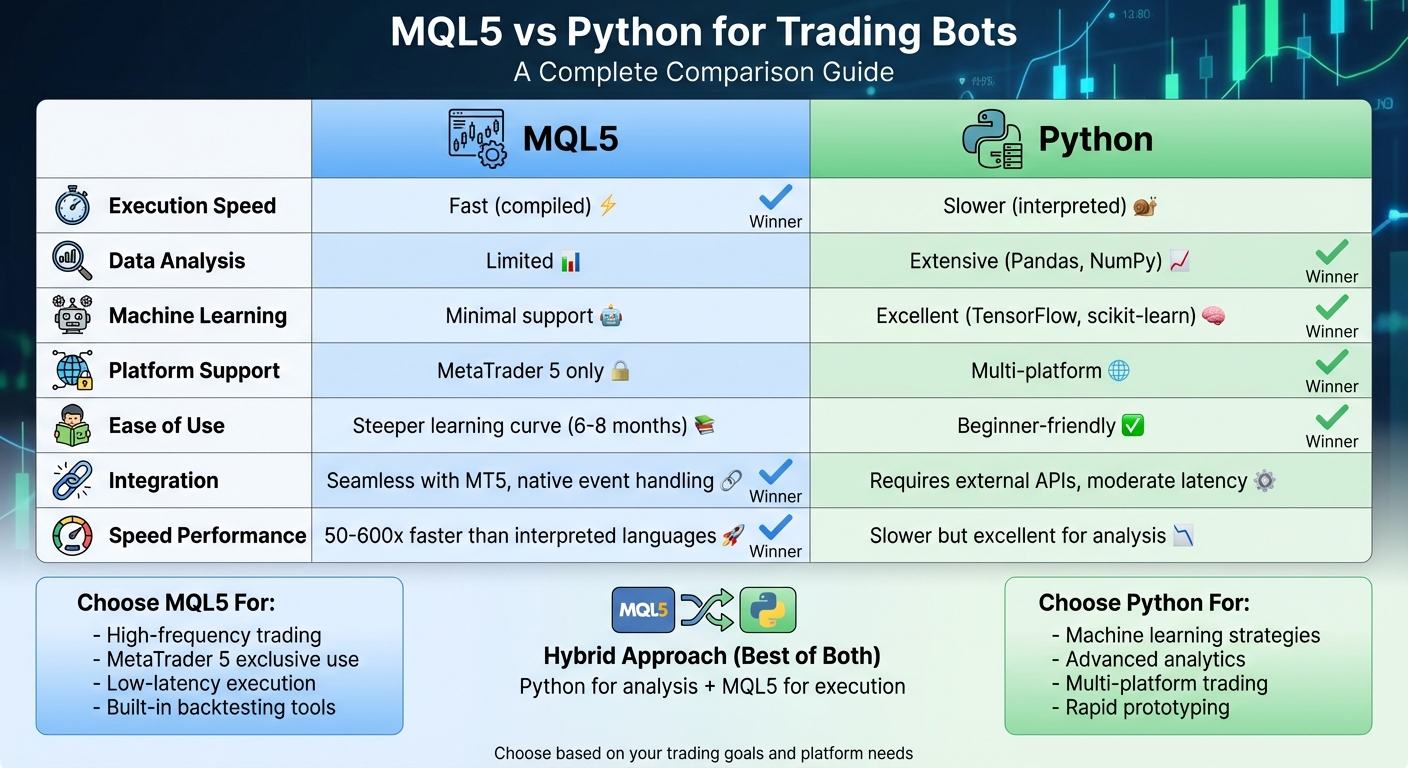
MQL5 vs Python Trading Bot Languages Comparison Chart
Python ↔ MQL5: Sending Real-Time Data Both Ways via Sockets
sbb-itb-3b27815
MQL5 for MetaTrader 5 Trading
MQL5 is a programming language crafted specifically for MetaTrader 5, designed to handle automated trading and custom indicators within a unified platform. As MetaQuotes Ltd. explains:
"MQL5 is designed for the development of high-performance trading applications in the financial markets and is unparalleled among other specialized languages used in the algorithmic trading."
MQL5 Features
MQL5 operates as a compiled language with syntax and performance akin to C++. Its event-driven structure allows Expert Advisors (EAs) to automatically respond to market movements using predefined handlers. For example, OnTick reacts to new price quotes, OnTimer handles scheduled tasks, and OnBookEvent monitors changes in market depth.
The language comes with MetaEditor, an integrated development environment (IDE) packed with tools like debugging, profiling, auto-completion, and version control via MQL5 Storage. Developers also gain access to a rich set of libraries, covering technical indicators, economic calendars, and numerical analysis through ALGLIB. Additional capabilities, such as OpenCL support for parallel computations, DirectX graphics, and built-in SQLite and .NET integration, expand its versatility.
MQL5 employs static typing, ensuring type compatibility is verified during compilation to avoid runtime errors. However, developers must manually manage memory, which adds a layer of complexity.
Benefits of Using MQL5
The language's features translate into notable advantages, particularly in terms of speed and precision.
As a compiled language, MQL5 processes market data and executes trades much faster than interpreted languages. This makes it ideal for high-frequency trading strategies where milliseconds can make a difference. Its seamless integration with MetaTrader 5 allows developers to build, test, and deploy trading applications all within the same platform. This integration provides direct access to market data, indicators, account details, and trade execution.
MQL5 supports five distinct application types:
- Expert Advisors: For fully automated trading.
- Custom Indicators: For in-depth data analysis.
- Scripts: For executing one-time tasks.
- Services: For running background operations.
- Libraries: For reusable code components.
The native event handlers ensure that strategies requiring real-time execution can react immediately to market changes, making MQL5 particularly suited for precision-focused trading.
MQL5 Drawbacks
Despite its strengths, MQL5 has some notable limitations.
The most significant drawback is its exclusivity to MetaTrader 5. Traders working across multiple platforms or brokers would need to rewrite their code or explore alternative solutions. Additionally, MQL5's C++-like syntax and object-oriented design create a steeper learning curve compared to languages like Python. The smaller developer community and limited third-party resources can also make it harder to find support or pre-built tools. Lastly, the need for manual memory management requires careful coding to avoid memory leaks, which could degrade performance over time.
Python for Multi-Platform Trading Bots
Python offers a flexible alternative to MQL5, stepping away from platform dependence and opening the door to integration across various brokers, data sources, and analytical tools. Its broad adoption in industries like finance showcases its ability to build advanced trading automation systems.
As an interpreted language with dynamic typing and automatic garbage collection, Python simplifies the testing process by eliminating the need for long compilations. Its clean and concise syntax boosts programmer efficiency, making it easier to quickly prototype and test trading strategies. Additionally, Python excels at connecting broker execution systems (like MetaTrader 5) with external tools for research, risk management, and monitoring. These qualities make Python a powerful choice for developing multi-platform trading solutions.
Python Features for Trading
What makes Python stand out is its extensive library ecosystem, tailored for data analysis and machine learning. For example:
- Pandas: Efficiently handles time-series data.
- NumPy: Delivers fast numerical computations, perfect for simulations and matrix operations.
- scikit-learn: Offers tools for building predictive models.
- TensorFlow and PyTorch: Enable the creation of complex neural networks.
For technical analysis, libraries like TA-Lib provide access to over 150 indicators, including RSI, MACD, and Bollinger Bands. Backtesting tools such as VectorBT and Backtrader allow users to test strategies with ease - whether through vectorized computations or object-oriented approaches. Connectivity tools like the MetaTrader5 package and CCXT further expand Python’s reach, enabling interaction with MT5 terminals and over 100 cryptocurrency exchanges.
Python’s integration with MetaTrader 5 is particularly noteworthy. Using the official MetaTrader5 package, developers can transfer trading algorithms and technical analysis seamlessly. This setup supports hybrid architectures where Python handles resource-heavy computations (e.g., machine learning), while MQL5 takes care of low-latency execution. With these tools, Python accommodates a broad spectrum of trading strategies.
Benefits of Using Python
Python’s flexibility makes it a go-to choice for traders managing multiple platforms and brokers. Unlike MQL5, which is tied exclusively to MetaTrader 5, Python enables multi-terminal setups. This allows a single parent process to oversee multiple child processes assigned to different terminal paths and accounts. Such a structure can help distribute risk across various brokers and strategies.
Another advantage is Python's large and active developer community. This means access to countless resources, tutorials, and pre-built libraries. Whether scraping fundamental data with Beautiful Soup or applying Modern Portfolio Theory using PyPortfolioOpt, there's likely a tool ready to save you time and effort. For production systems, Python can also integrate with MQL5 Expert Advisors through lightweight APIs built with Flask, enabling scalable and modular architectures.
Python Drawbacks
That said, Python isn’t without its challenges. Its interpreted nature results in slower execution compared to compiled languages like MQL5, which delivers performance on par with C++. This can be a critical limitation for real-time or high-frequency trading, where even small delays can have significant impacts.
Another limitation is Python’s lack of native event handlers like MQL5’s OnTick or OnBookEvent. Developers often resort to workarounds, such as infinite polling loops, which can add complexity and slow down response times to market changes. Additionally, while Python libraries like TA-Lib can calculate indicators, accessing proprietary MetaTrader indicators requires custom integration efforts. Compatibility can also be an issue, as some broker integration tools - like the official MetaTrader5 package - are primarily designed for Windows environments.
MQL5 vs Python: Side-by-Side Comparison
Here’s a direct breakdown of how MQL5 and Python stack up against each other, particularly from the perspective of trading bot development.
Speed and Performance
When it comes to raw execution speed, MQL5 is the clear frontrunner. As a compiled language, its performance is nearly on par with C++, making it an excellent choice for high-frequency trading scenarios. On the other hand, Python's interpreted nature inherently slows it down.
MQL5 also integrates directly with MetaTrader 5, avoiding the need for external communication. Meanwhile, Python relies on APIs like named pipes to connect with trading platforms, which adds latency. In fact, MQL5 has been shown to handle calculations 50–600 times faster than some other trading-focused languages.
However, Python dominates in areas where MQL5 falls short, particularly in data analysis and machine learning. With libraries like NumPy, Pandas, and TensorFlow, Python excels at processing large datasets and building predictive models.
| Factor | MQL5 | Python | Winner |
|---|---|---|---|
| Execution Speed | Fast | Slower | MQL5 |
| Latency | Low | Moderate | MQL5 |
| Data Analysis Capabilities | Limited | Extensive | Python |
| Machine Learning Integration | Minimal | Excellent | Python |
| Platform Integration | Seamless (MT5) | Broad | Depends on use |
| Backtesting Tools | Built-in | Customizable | Tie |
These distinctions highlight the strengths of each language, setting the stage for a closer look at usability and how they handle hybrid workflows.
Learning Curve and Usability
For beginners, Python is much easier to pick up. Its clean syntax, dynamic typing, and automatic memory management make it approachable. It’s no surprise that Python ranked third in the TIOBE Programming Language Popularity Rankings in July 2021, with a score of 10.95%.
MQL5, with its C++-style syntax and static typing, has a steeper learning curve. However, for trading-specific tasks, it can actually feel more accessible. Why? Everything is bundled into one package: the MetaEditor IDE, backtesting tools, and broker connectivity. These built-in tools eliminate the need for extensive configuration. The MQL5 Wizard simplifies things further by generating template code for Expert Advisors, so you don’t have to start from scratch.
In contrast, Python requires a more hands-on setup. You’ll need to install the interpreter, configure environment variables, and use pip to add essential packages like MetaTrader5, pandas, and matplotlib.
| Aspect | MQL5 | Python |
|---|---|---|
| Syntax | Optimized for trading but more complex | Simple and beginner-friendly |
| Libraries | Limited to the MT5 ecosystem | Extensive (e.g., pandas, NumPy) |
| Development Environment | Specialized for MT5 | Flexible with many IDEs |
| Community Support | Focused on trading | Broad and diverse |
Using Both Languages with Traidies

Many professional traders combine the strengths of both MQL5 and Python. Python handles heavy data analysis and machine learning tasks, while MQL5 takes over for fast, low-latency trade execution.
This hybrid approach is where Traidies shines. Its AI Strategy Parser allows you to generate MQL5 code straight from natural language descriptions. Whether your strategy involves a simple moving average crossover or a complex multi-indicator system, Traidies can translate it into optimized MQL5 code that’s ready for backtesting.
If you prefer Python for its analytical power, you can develop and test strategies there, then use Traidies to convert them into MQL5 for live execution on MetaTrader 5. This setup gives you the best of both worlds - Python’s rich analytical environment paired with MQL5’s high-speed execution - without the usual integration headaches.
Backtesting, Optimization, and AI Features
MQL5 Backtesting and Optimization
MQL5 comes equipped with a built-in Strategy Tester designed specifically for MetaTrader 5. This allows users to backtest strategies directly within the platform, eliminating the need for external tools. The Strategy Tester can handle multi-currency and multi-timeframe data seamlessly - tasks that typically require additional customization elsewhere.
When it comes to optimization, MQL5 supports various techniques, including Brute Force (testing all parameter combinations), Grid Search, and Random Search. Additionally, it uses evolutionary and genetic algorithms to fine-tune strategies. One of its standout features is speed. Since MQL5 runs natively within the MetaTrader ecosystem, there’s no lag from external API calls. Everything operates close to the trade server, making the process both faster and more efficient.
To optimize effectively, align your schedule with market volatility. For low-volatility periods, use a 50–100 day lookback and re-optimize every 1–3 months. In high-volatility markets, shorten the lookback to 10–20 days and re-optimize every 2–4 weeks. Also, make sure to release indicators using IndicatorRelease() during intensive optimization runs to prevent overloading your terminal.
Python Backtesting and Optimization
Python takes a different route, relying on libraries like Pandas and NumPy for data manipulation and analysis. This makes it a great choice for rapid prototyping and testing unconventional ideas without being tied to a single platform. Python’s flexibility allows you to adjust models, create in-depth visualizations, and explore ideas freely.
"Python programs are an excellent tool to try ideas, create graphics quickly and confirm theoretical statements with historical trading data." - MQL5.community
However, Python doesn’t have built-in backtesting tools. You’ll need to either build your framework or integrate an external one. To pull historical data from MetaTrader 5, the MetaTrader5 package is essential. For example, a single command can download over 86,000 rows of M1 data in seconds. While setting up Python for backtesting requires more effort upfront, it gives you full control over how you test and validate strategies. Beyond backtesting, Python and MQL5 diverge even further when it comes to advanced AI features.
AI and Machine Learning Support
Python shines in the realm of machine learning, thanks to its robust ecosystem of libraries like scikit-learn, TensorFlow, XGBoost, and Prophet. It’s particularly strong in feature engineering, enabling techniques such as spike z-scores, MACD differences, and Gaussian Mixture Model clustering - tasks that are challenging to implement directly in MQL5.
For example, a Gradient Boosting model achieved a 72.88% win rate during a 30-day backtest on the Boom 300 Index. Another strategy using XGBoost with bagging and boosting reached 73% classification accuracy for a 1:8 risk-reward ratio. These examples highlight Python’s ability to handle complex AI-driven tasks effectively.
MQL5, on the other hand, has limited native support for machine learning. Without specialized libraries, implementing advanced AI models can be cumbersome. However, MQL5 supports ONNX (Open Neural Network Exchange), which allows traders to train models in Python and then deploy them in MetaTrader 5. This hybrid approach is popular: Python handles data preparation, feature engineering, and model training, while MQL5 executes the model for real-time trading. Some traders even use a Flask API in Python to serve as an inference engine, with MQL5 polling it for trading signals.
Ultimately, your choice of language should depend on your priorities. If speed and execution are key, MQL5 excels. If your focus is on analytical depth and flexibility, Python offers unmatched capabilities.
Conclusion: Which Language Should You Choose?
Key Points
The language you choose depends largely on your trading goals and the platform you're using. MQL5 is ideal for those who need fast execution, built-in event handling, and integrated backtesting tools. On the other hand, Python excels in areas like machine learning and data analytics, thanks to its powerful libraries like TensorFlow and scikit-learn. However, Python's interpreted nature means it connects to MetaTrader 5 through external APIs, which might add some processing overhead.
A hybrid strategy is also gaining traction among traders. For example, you could use Python for tasks like feature engineering and model training, then deploy those models in MQL5 through a Flask API. If you're using Traidies, you can take advantage of its AI-driven tools to quickly generate MQL5 code and integrate Python-based models for deeper analytics.
Recommendations
Here’s how to decide based on your trading needs:
- Go with MQL5 if your focus is entirely on MetaTrader 5. It’s perfect for high-frequency trading, using the native Strategy Tester, and accessing MetaQuotes VPS without relying on external tools. While it takes about 6 to 8 months to learn the basics, the speed advantages make it worth the effort for time-sensitive strategies.
- Opt for Python if your strategy leans heavily on machine learning, advanced analytics, or cross-platform compatibility. Its straightforward syntax and extensive library ecosystem make it a great choice for these tasks.
- Combine both languages for complex systems. Use Python for analytical tasks like model development and data processing, and let MQL5 handle real-time execution. Just remember to whitelist API endpoints in MetaTrader settings when connecting via web requests.
Each option has its strengths, so the best choice often depends on how you balance analysis with execution.
FAQs
Can I use Python to place trades on MetaTrader 5 without MQL5?
Yes, you can use Python to execute trades on MetaTrader 5 without needing MQL5. By leveraging the MetaTrader5 library, Python connects directly to the platform, enabling you to place trades, retrieve market data, and manage orders. This approach provides flexibility and full control over trading operations, making it an excellent choice for traders who are comfortable working with Python.
What’s the simplest way to combine Python analysis with MQL5 execution?
The easiest method to link Python's analytical capabilities with MQL5's execution is through direct communication. MetaTrader 5 offers Python integration, allowing Python scripts to work alongside the trading terminal. You can exchange data using methods like files (e.g., CSV), sockets, or APIs. For real-time interactions, consider setting up a local server or a socket connection to enable smooth data exchange between Python and MQL5.
How do I reduce latency when a Python bot sends orders to MT5?
To cut down on latency, it's a good idea to host your Python script on a server that's geographically close to your broker's server. Alternatively, you can use a low-latency VPS to improve speed. Alongside this, focus on optimizing your network connection and trimming any unnecessary computations in your code. For an extra performance boost, try using socket communication between Python and MT5. This approach helps reduce the overhead caused by frequent API calls, ultimately leading to quicker order execution.