How AI Enhances Automated Risk Alerts in Trading
How AI Enhances Automated Risk Alerts in Trading
AI is reshaping risk management in trading by making alerts faster, smarter, and more accurate. Traditional systems, based on static rules, often fail to handle rapid market shifts or prevent false alarms. AI-powered alerts solve these issues by learning from market patterns, predicting risks, and processing data in real time. Here's what you need to know:
- AI predicts risks before they happen using models like LSTM networks, which analyze historical data for early warnings.
- False alarms are reduced through advanced pattern detection and multi-layer validation, ensuring traders focus only on actionable alerts.
- Real-time processing enables AI to analyze thousands of securities and adjust trading parameters dynamically, based on market conditions.
For traders, this means fewer losses, better decision-making, and faster responses to volatile markets. Platforms like Traidies simplify the setup by converting plain-language rules into MQL5 code, making AI risk alerts accessible to all skill levels. Want to stay ahead? AI-driven systems are the future of risk management.
Wheel Strategy Gets an AI Upgrade - Here’s My AI Risk Filter
sbb-itb-3b27815
What Are Automated Risk Alerts?
Automated risk alerts are like having a vigilant safety net for your trading activities. These systems monitor market data and account metrics in real time, stepping in when risk thresholds are breached. Imagine them as a set of guardrails, constantly scanning for red flags like extreme price swings, margin calls, or sudden drawdowns that could threaten your capital.
What makes these systems so effective is their ability to process massive amounts of data simultaneously. For instance, they can track multiple currency pairs and market conditions - tasks that would overwhelm any human trader. Let’s say your daily loss limit is set at 5%, or a position veers off course by a certain percentage. The moment these thresholds are crossed, the system either notifies you or takes immediate action to protect your account.
Automation is no longer optional in today’s fast-paced trading environment. With 60% to 70% of trades now executed algorithmically, the markets move at lightning speed. A stark example is the May 6, 2010 "Flash Crash", where automated systems caused nearly $1 trillion in market value to evaporate in minutes. Automated risk alerts are crucial for preventing trading systems from contributing to - or falling victim to - such chaos. Understanding how these systems work is key to grasping the role of modern AI in risk management.
Main Parts of Automated Risk Alerts
Automated risk alerts rely on three key components to manage risks in real time:
- Data Collection: This is where it all begins. Market data like prices, volumes, and volatility, along with account metrics such as equity, margin, and open positions, are continuously gathered. The data streams in from exchanges, brokers, and even news feeds, feeding into the system’s processing engine.
- AI Analysis Engine: Here’s where the magic happens. The analysis engine uses machine learning models, such as Random Forests or LSTM networks, to detect anomalies and predict potential risks. For example, if Bitcoin usually fluctuates by 2% per hour but suddenly spikes 8% in five minutes, the system flags this as a potential problem worth investigating.
- Alert and Execution Layer: Once a risk is identified, this layer jumps into action. Alerts are sent via email, push notifications, or dashboard updates. In more advanced setups, it can even take direct action, like closing positions or blocking new trades to prevent further losses. Some systems go a step further by using webhooks to send signals directly to brokers or trading bots, executing force-close orders automatically.
Problems with Older Risk Alert Systems
Older risk alert systems simply can’t keep up with today’s rapid trading environment. Here’s why:
- Sluggish Response Times: Traditional systems, often reliant on manual processes or spreadsheets, are too slow for high-frequency trading, where prices can shift in milliseconds. By the time a human reacts, the damage may already be done.
- False Alarms: Many older systems rely on static thresholds that don’t adjust to changing market conditions. This results in a flood of false alerts, leading to "alert fatigue", where traders start ignoring warnings - even when they’re real.
- Lack of Flexibility: These systems can’t adapt to evolving market dynamics and are often influenced by human emotions. For example, traders might override manual risk controls in a moment of frustration, engaging in "revenge trading" after a loss.
As Adnan Masood, PhD, an expert in AI and machine learning, explains:
"Trade surveillance is shifting from static, rule-driven monitoring to adaptive, intelligence-led oversight that can keep pace with complex markets."
AI-powered systems address these shortcomings by learning from market behavior, adjusting to changes, and enforcing risk controls without hesitation or emotional interference.
How AI Improves Risk Alerts in Trading
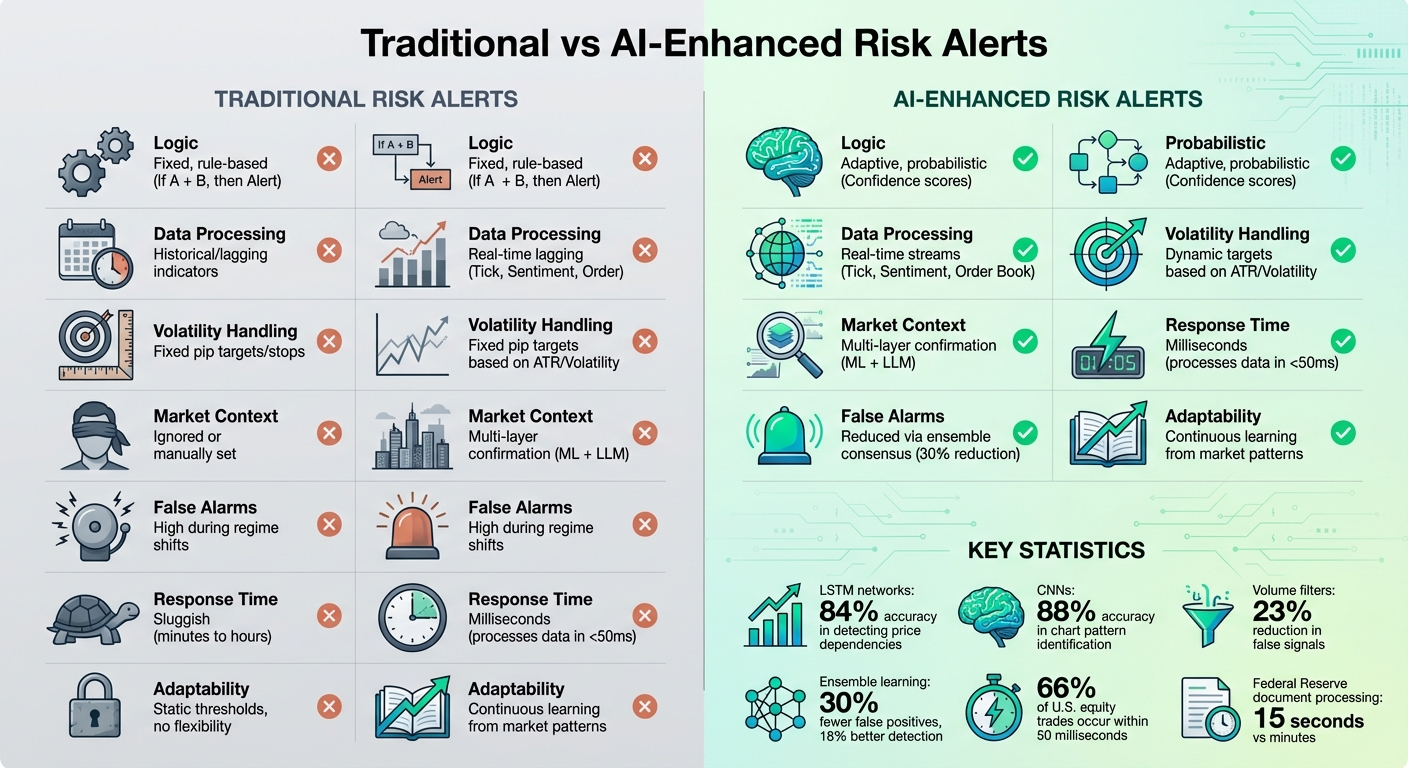
Traditional vs AI-Enhanced Risk Alerts in Trading: Key Differences
AI has transformed risk alerts from reactive to proactive tools in trading. Instead of merely flagging issues after they occur, AI analyzes patterns, predicts potential threats, and processes data at speeds that traditional systems can't match. Here’s how it tackles the key limitations of older alert systems.
Predictive Analytics for Early Warnings
AI doesn't just react - it anticipates. Using Long Short-Term Memory (LSTM) networks, it analyzes historical data to forecast volatility trends before major market swings. These networks boast an impressive 84% accuracy in detecting long-term price dependencies, giving traders the chance to adjust their strategies ahead of time.
Machine learning models like Random Forests and Gradient Boosting Machines also play a significant role. They identify patterns linked to past market crashes or drawdowns, enabling traders to mitigate risks effectively. By continuously assessing whether the market is trending, ranging, or transitioning, AI fine-tunes risk parameters in real time. Enhanced pattern recognition further sharpens these early warnings, filtering out unnecessary noise.
Pattern Recognition and Anomaly Detection
AI’s ability to detect patterns and anomalies in real time gives it an edge over traditional systems. Convolutional Neural Networks (CNNs) achieve up to 88% accuracy in identifying visual chart patterns, while LSTM networks capture intricate price relationships that rule-based systems often overlook.
Modern AI systems employ multi-layer validation, where machine learning models score signals, and Large Language Models (LLMs) confirm their relevance in the market. This dual-layer approach significantly cuts down on false alarms, ensuring only actionable alerts reach traders.
"AI fundamentally transforms pattern identification by overcoming human limitations... Machine learning algorithms can analyze thousands of data points across multiple timeframes without fatigue or bias." - PageOn.ai
AI-driven strategies have also shown measurable improvements. For example, volume filters powered by AI have reduced false signals by 23%, and ensemble learning techniques - combining multiple models - have lowered false positives by 30% while boosting detection accuracy by 18%. By requiring consensus from various model variants, AI effectively filters out market noise.
Real-Time Data Processing
Speed is everything in trading, where markets can shift in milliseconds. AI processes data through a rapid four-step pipeline: data ingestion, feature computation, model inference, and signal formatting - all completed in milliseconds. This speed is critical, given that about 66% of U.S. equity trading volume happens within 50 milliseconds of a price change.
While traditional systems are limited in scope, AI can analyze thousands of securities simultaneously across multiple timeframes. With the addition of Large Language Models, AI can now interpret complex Federal Reserve documents almost instantly, allowing market prices to react within 15 seconds instead of minutes.
Natural Language Processing (NLP) models take this a step further by converting unstructured text - like news articles, earnings reports, and social media posts - into sentiment scores that feed directly into risk prediction systems. As a result, stop-loss and take-profit levels dynamically adjust in real time based on metrics like Average True Range (ATR).
Research shows that ignoring AI signals with less than 75% confidence can reduce losses by 20–30% during volatile market conditions. This real-time processing capability ensures traders stay ahead of potential risks, shifting from reactive to proactive risk management.
| Feature | Traditional Risk Alerts | AI-Enhanced Risk Alerts |
|---|---|---|
| Logic | Fixed, rule-based (If A + B, then Alert) | Adaptive, probabilistic (Confidence scores) |
| Data Processing | Historical/lagging indicators | Real-time streams (Tick, Sentiment, Order Book) |
| Volatility Handling | Fixed pip targets/stops | Dynamic targets based on ATR/Volatility |
| Market Context | Ignored or manually set | Multi-layer confirmation (ML + LLM) |
| False Alarms | High during regime shifts | Reduced via ensemble consensus |
Building AI-Powered Risk Alerts with MQL5
This section dives into how you can integrate AI-powered risk alerts into MQL5 code. The good news? You don’t need to be a programming expert to make it happen. With the right tools, traders can describe their risk management rules in plain English and quickly turn those ideas into functional MQL5 code. The process involves three main steps: generating the code, testing it with historical data, and setting up real-time alerts.
Creating MQL5 Code with Traidies AI Tools
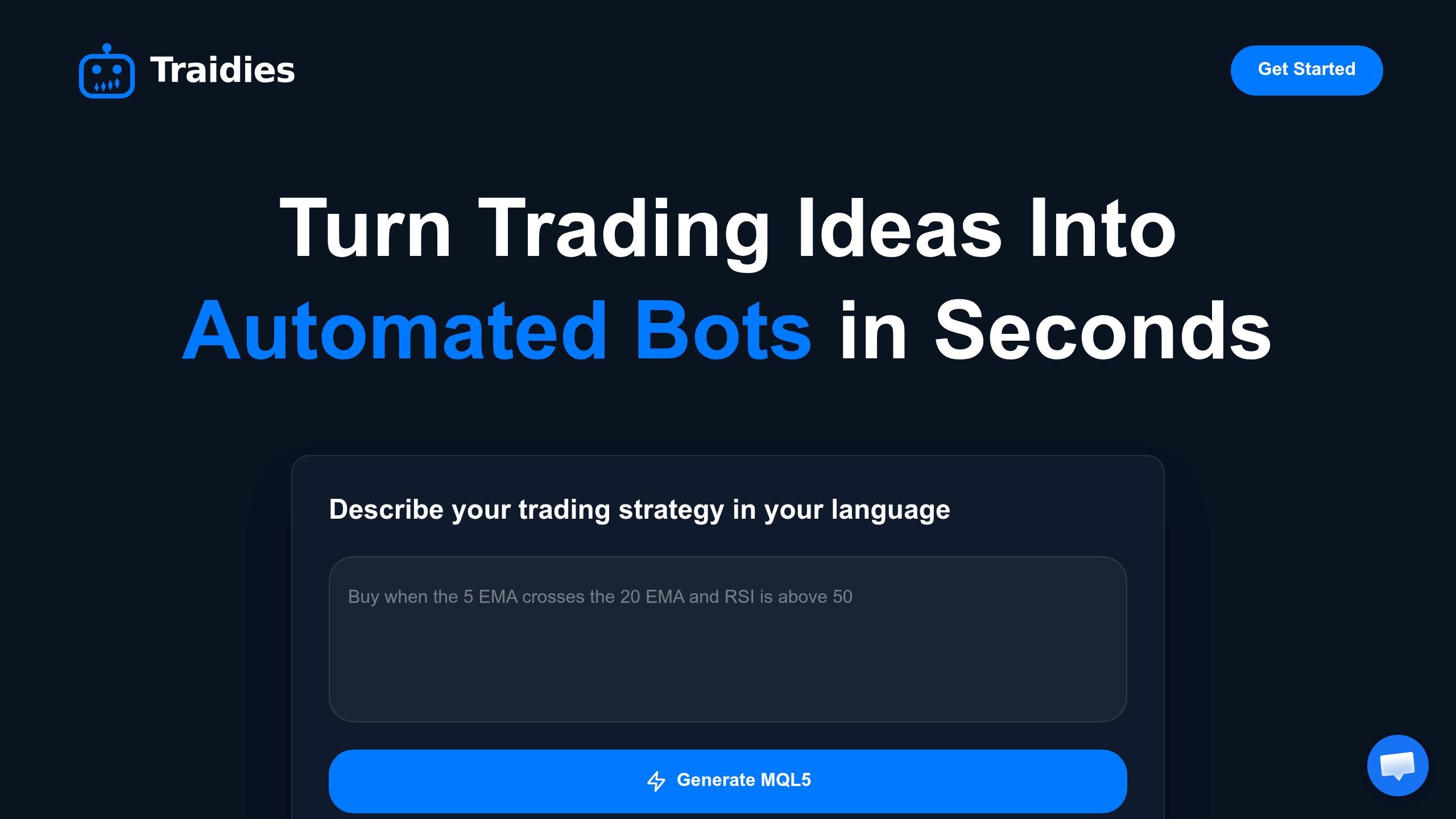
Traidies' AI Strategy Parser is a game-changer for traders looking to translate their trading ideas into executable code. By simply describing risk management rules like, "close all positions if daily loss exceeds 5%", the AI generates the corresponding MQL5 code. Here’s how it works: the tool first converts your plain-language instructions into pseudocode to minimize misunderstandings. Then, it creates the final MQL5 code.
This approach automates many tedious tasks, such as defining variables for alert times, sound notifications, and messages. For stricter trade signals, the AI can also generate structured JSON outputs. These outputs include precise buy/sell instructions, complete with entry points, stop-loss (SL), and take-profit (TP) levels.
The tool also modularizes the code by keeping the interface components separate from the core risk logic. When setting AI temperature parameters for code generation, use low settings (0.1–0.5) to produce precise outputs like trade signals. Medium settings (0.5–1.0) are better suited for general programming tasks.
Once the code is generated, it’s critical to validate its performance through rigorous backtesting.
Testing Risk Alerts with Historical Data
Before deploying your risk alert system, thorough testing with historical data is a must. Traidies offers a feature called "EA Virt", which lets you create a virtual copy of your strategy. This virtual environment simulates how the system would have performed from a past date to the present.
Start by testing standard risk parameters, such as a 2% risk per trade or a 5% daily drawdown, and adjust them based on the results. Break the code into smaller modules and test each one individually to pinpoint any errors. Use fitness functions - like profit factor, mathematical expectation, or drawdown limits - to assess the strategy’s quality during backtesting. Additionally, enable CSV logging to record every trade and state change. This creates a detailed record for post-analysis.
Finally, run the system on a demo account for 50 to 100 trades. This step helps build confidence in the system before it goes live.
Once testing is complete, you’re ready to configure robust real-time alerts.
Configuring Real-Time Alerts
MQL5 provides powerful tools like OnTick() and OnTradeTransaction() to ensure no risk event goes unnoticed. These functions continuously monitor price movements and profit/loss on every market tick while also detecting trades initiated manually or by other Expert Advisors (EAs).
Set the system to track multiple thresholds, such as daily or weekly loss limits, maximum drawdowns from equity peaks, and symbol-specific exposures. Instead of relying on fixed thresholds, AI-driven alerts can calculate dynamic levels. For example, you could set RSI alerts at twice the average historical deviation. This adaptive method has been shown to boost profitability by about 19.5% while reducing the total number of trades by 11%.
"By codifying rules, we transform discipline from a conscious struggle into an automated background process."
– Clemence Benjamin, MQL5 Author
To ensure persistence, store critical risk states (like "RE_DailyPL") using MQL5 Global Variables. Configure the system to check conditions every 3 seconds to maintain efficiency without overloading the platform. Before implementing automated stop-loss changes, verify the current price isn’t within the broker’s restricted zone using SYMBOL_TRADE_FREEZE_LEVEL.
For high-risk scenarios, consider a two-stage closing strategy. First, attempt a standard PositionClose(). If that fails due to market conditions, use an opposing market order as a backup to ensure closure.
Best Practices for Using AI Risk Alerts
Fine-tuning AI risk alerts with thoughtful practices can help you manage risks effectively and stay ahead in dynamic markets.
Setting Alert Thresholds
Setting the right alert thresholds can safeguard your capital while avoiding unnecessary interruptions. Volatility-adjusted thresholds are a smart way to adapt to market fluctuations. For instance, metrics like Average True Range (ATR) or standard deviation help adjust stop-loss levels. Setting stop-losses at 2x the ATR can shield you from premature exits during volatile spikes while maintaining tighter protection in calmer markets. Similarly, progressive risk reductions - like cutting exposure by 25% at a 3% drawdown and 50% at 5% - are often more effective than shutting down entirely.
Your trading strategy also plays a role in determining sensitivity. Scalping, for example, works best with tight thresholds of 0.2–0.5%, while swing traders might need wider thresholds of 5–10% to allow trades to develop.
Remember, recovering from major losses is no small feat. A 50% drawdown requires a 100% gain to break even, while a 75% drawdown needs a 300% return. That’s why many experienced traders follow the 1–2% rule - risking no more than 1–2% of their portfolio on a single trade. For example, during a simulated 30% Bitcoin crash over two days, a trader using tight stop-losses and position caps limited their loss to just 8%, compared to a staggering 45% loss for someone without those safeguards.
Once your thresholds are set, consider layering in additional safety measures to strengthen your approach.
Adding Safety Measures
An essential tool for risk management is the kill switch. Set a hard daily loss limit - typically 2–3% of your portfolio. If this limit is hit, the AI halts trading until the next session. This prevents emotional decisions, like "revenge trading", which can lead to devastating losses.
"A bot without a stop loss is like a car without brakes. It goes fast until it hits something." – VibeTrader Team
Other safeguards include spread and slippage guards, which ignore trading signals when spreads or slippage exceed twice their usual levels. Additionally, correlation caps can limit exposure by ensuring no more than 30% of your portfolio is tied to a single sector or two pairs of the same base currency. This helps prevent cascading losses from a single market event. Professional risk management often involves risking only 0.25% to 2% of total equity per trade.
It’s also wise to pause trading after 4–6 consecutive losses and use a VIX filter to pause aggressive strategies when the VIX exceeds 30. For instance, during the March 2020 pandemic crash, high-frequency bots with a 5% drawdown pause avoided catastrophic losses.
Moving from Testing to Live Trading
Before going live, start with paper trading for at least 2–4 weeks, though extending this period to 30–90 days is even better. This testing phase ensures your thresholds are neither too sensitive (causing frequent triggers) nor too lax (missing critical signals). For example, in Q2 2023, an Ethereum grid bot that used ATR and RSI filters avoided liquidation during heavy volatility and still achieved a 9% ROI in a range-bound market.
When transitioning to live trading, begin with conservative limits and small capital amounts. After any drawdown pause, resume trading cautiously with 50% of your usual position sizes for the first week. Tools like global variables in MQL5 can help your bot "remember" risk states, such as daily profit or loss limits, even after platform restarts.
To maintain effectiveness, establish weekly or monthly review cycles. Use these reviews to analyze trade logs, evaluate drawdown levels, and assess the performance of your alerts. High-quality AI risk systems have been shown to reduce drawdowns by up to 40% compared to manual trading, but they require consistent monitoring and adjustments to keep up with changing market conditions.
Conclusion
AI-powered risk alerts bring together predictive analytics, pattern recognition, and real-time data processing to outperform traditional rule-based systems. By using multi-layer validation to cross-check signals against market conditions, these systems drastically cut down on false alarms triggered by news spikes or liquidity gaps. The result? Fewer unnecessary exits and more confidence in your trading decisions.
Consider this: AI can process intricate Federal Reserve documents and stabilize market responses in just 15 seconds. In a market where 66% of U.S. equity trades happen within 50 milliseconds of a price change, this kind of speed is a game-changer. AI systems also adjust dynamically, modifying stop-loss and take-profit levels according to real-time volatility instead of sticking to static pip targets. This adaptability highlights why industry experts see AI as a transformative force.
"AI transforms trading platforms from reactive systems into proactive, intelligent risk-management engines." – Kitrum
For traders eager to leverage these capabilities, platforms like Traidies eliminate the technical hurdles. With tools that let you describe risk management strategies in plain language, instantly generate MQL5 code, and backtest using historical data, you don’t need coding skills to tap into advanced AI-driven solutions. Traidies is just one example of how AI is simplifying complex risk management for traders at all levels.
The numbers speak for themselves. Businesses report saving 25% of their time and completing stress-test reporting 50% faster with AI-powered forecasting. This momentum solidifies AI's role as a competitive edge in risk management. Whether you're managing a personal portfolio or navigating a complex trading strategy, AI risk alerts offer the precision and speed necessary to thrive in today’s fast-paced markets.
FAQs
How does AI know an alert is real and not noise?
AI works to pinpoint genuine alerts by sifting through vast amounts of real-time and historical market data. It identifies patterns that signal real risks or opportunities. With machine learning, it adjusts to market shifts and filters out noise caused by random fluctuations. This process significantly cuts down on false positives, ensuring traders get precise, actionable alerts. As a result, automated risk management systems become more dependable, even in highly volatile markets.
What data should an AI risk alert system monitor in real time?
Real-time monitoring of market data is essential for an AI risk alert system. This involves tracking key factors like price, trading volume, order books, market sentiment, and pattern recognition. By analyzing these elements, the system can quickly detect and address potential risks with improved precision and speed.
How can I add AI risk alerts to my MQL5 bot without coding?
You can integrate AI risk alerts into your MQL5 bot without writing a single line of code. How? By using AI-driven tools that convert natural language descriptions of strategies into executable code. For example, platforms like Traidies let you quickly create automated bots, complete with features like risk alerts. All you need to do is describe your strategy, and the platform handles the rest, generating the required MQL5 code for you. This approach makes the process straightforward and saves you from the hassle of manual coding.