Optimizing Risk Management with AI in MQL5

Optimizing Risk Management with AI in MQL5
AI is transforming how traders manage risk in MQL5 by automating processes and making data-driven decisions. Here's what you need to know:
- MQL5 is a programming language for creating automated trading systems in MetaTrader 5, enabling traders to handle tasks like position sizing, slippage monitoring, and spread control.
- AI integration shifts risk management from static rules to dynamic strategies, adapting to market changes and avoiding emotional biases.
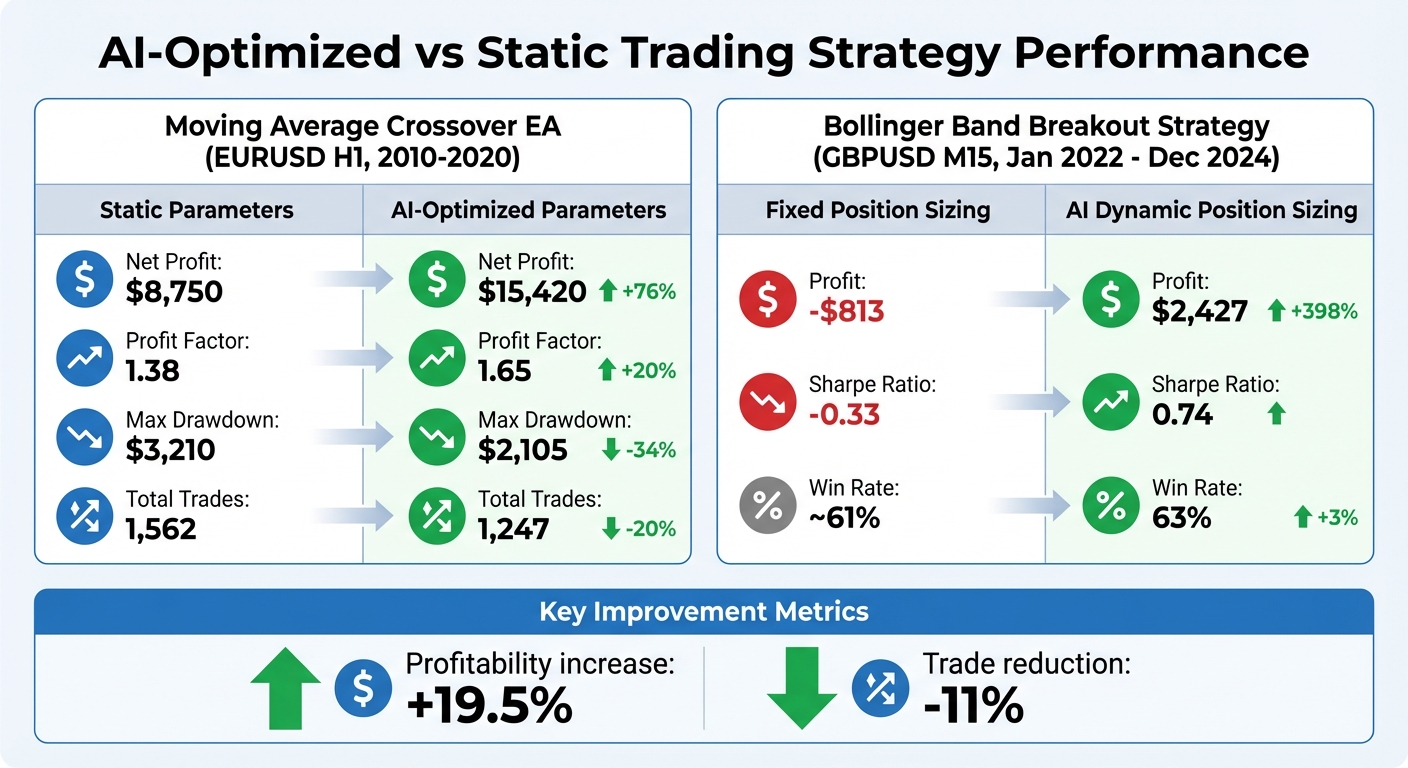
- Backtests show AI-driven strategies can increase profitability by 19.5% while reducing trades by 11%.
- Tools like ONNX and cloud-based APIs (e.g., ChatGPT) allow seamless AI integration into MQL5 for real-time trade execution.
- AI methods include dynamic position sizing, risk-reward optimization, and session-specific risk adjustments.
- Backtesting with high-quality data and tools like Traidies ensures strategies perform effectively before live deployment.
- Ongoing monitoring and adjustments are crucial to maintain strategy performance and address market changes.
Setting Up MQL5 for AI Risk Management
Preparing MQL5 for Automation
To get started, install MetaTrader 5 and arrange for a VPS to ensure your Expert Advisor (EA) operates around the clock. A trading VPS typically costs about $15 per month, though some brokers may offer it for free if you meet specific requirements, such as maintaining a minimum deposit (e.g., $100) and achieving a set weekly trading volume (e.g., 0.01 lots).
Set up your trading environment with demo accounts or trial accounts from prop firms like FTMO. These accounts are ideal for testing AI-driven risk management strategies and validating essential parameters like maximum daily losses, weekly drawdown limits, and profit targets.
In your MQL5 code, define essential variables, including a unique Magic Number, your lot-sizing approach, and the risk mode (e.g., personal trading vs. prop firm requirements). Leverage functions such as OnInit(), OnDeinit(), OnTick(), and OnTradeTransaction() alongside the Trade/Trade.mqh library and the CTrade class. These tools enable automated trade execution, including the management of Stop Loss and Take Profit orders.
This setup ensures a solid foundation for integrating AI tools into your trading workflow.
Connecting AI Tools to MQL5
Once your MQL5 environment is ready, the next step is selecting the right AI integration method for your strategy. If you prefer embedding AI models directly into your EA for optimal performance, use ONNX with Opset version 14.
For cloud-based AI solutions, such as ChatGPT or custom Flask/FastAPI servers, use the WebRequest() function to exchange market data and receive trade signals. To enable this, add your AI tool's URL in MetaTrader 5 by navigating to Tools > Options > Expert Advisors.
When configuring the AI model, set the temperature parameter between 0.1 and 0.5. This range ensures the generation of consistent and deterministic JSON trade signals.
For a more streamlined approach, platforms like Traidies can help. They simplify the process by converting natural language instructions into MQL5 code while also managing configuration and automated backtesting using historical data.
sbb-itb-3b27815
I Built an MT5 Risk Manager with Claude in 10 Minutes (No Coding Required)
AI Methods for Risk Management in MQL5
AI-Optimized vs Static Trading Strategy Performance Comparison
AI brings a dynamic edge to risk management, moving beyond rigid rules to adapt in real time to market conditions. Here's how AI reshapes risk strategies in MQL5.
Dynamic Position Sizing with AI
AI transforms static position sizing into a flexible system that adjusts to market shifts. One useful method involves logistic regression to calculate a "confidence score" (ranging from 0 to 1) for each trade setup. By applying a sigmoid function to key market variables - like open, high, low, and close prices - AI generates probabilities for trades. Thresholds are then set dynamically based on the prediction range, allowing the system to adapt to market volatility without human interference.
As Ndawana explains, "Human traders take risk when they expect payoff. We aim to give our computer similar flexibility".
Between January 2022 and December 2024, Ndawana tested this approach with a Bollinger Band breakout strategy on GBPUSD (M15 timeframe). The AI-enhanced version delivered $2,427 in profit with a Sharpe ratio of 0.74, compared to the original fixed-size strategy, which lost $813 and had a Sharpe ratio of -0.33. The win rate also climbed slightly to 63%.
To manage account growth, position sizes can be normalized using this formula:
CurrentLot = FixedLot × (TotalBalance / FittedBalance)
Here, "Fitted Balance" represents the account size at which a fixed lot would result in a 10% drawdown, ensuring risk remains proportional as the account grows.
Next, let’s explore how AI fine-tunes the risk-reward balance.
AI-Based Risk-Reward Ratio Optimization
Setting optimal stop-loss and take-profit levels is crucial, especially when factoring in market volatility. AI can integrate historical data using functions like CopyBuffer and CopyRates, incorporating indicators like ATR (Average True Range) or RSI (Relative Strength Index) into optimization processes.
A practical approach combines walk-forward optimization with multi-criteria evaluation. Instead of focusing solely on profits, this method balances metrics such as the Sharpe ratio, maximum drawdown, and profit factor. For instance, testing an auto-optimizing Moving Average Crossover EA on EURUSD (H1 data from 2010–2020) produced these results:
| Metric | Static Parameters | AI-Optimized Parameters |
|---|---|---|
| Net Profit | $8,750 | $15,420 |
| Profit Factor | 1.38 | 1.65 |
| Max Drawdown | $3,210 | $2,105 |
| Total Trades | 1,562 | 1,247 |
For real-time adjustments, the CTrade library and PositionModify function can dynamically update stop-loss and take-profit levels as market conditions change. A common method is to set stops at multiples of ATR (e.g., 2× ATR for stop-loss and 3× ATR for take-profit). Adding automatic break-even logic - where the stop is moved to the entry price plus a small buffer after reaching a profit target - further strengthens risk control.
These techniques pave the way for session-specific adjustments.
Session-Specific Risk Adjustments
Each trading session has its own volatility profile, and AI can tailor risk parameters to match these unique conditions rather than applying a blanket rule.
Long Short-Term Memory (LSTM) networks are particularly effective for this, as they analyze sequential market data and identify long-term patterns. You can develop LSTM models in Python, export them as .h5 files, and access them in MQL5 via WebRequest(). This setup allows the EA to send OHLC data and receive real-time trade instructions.
For simpler setups, ATR can be used to classify volatility and adjust risk tiers (e.g., allocating 2% risk for high-volatility sessions and 0.5% for low-volatility ones). Additionally, refined RSI strategies that calculate dynamic midpoints based on historical averages and standard deviations have shown to boost profitability by about 19.5%, while reducing the total number of trades by 11% compared to fixed-level strategies.
To maintain consistent risk management, MQL5 Global Variables (using functions like GlobalVariableSet and GlobalVariableGet) can store session-specific data, such as daily profit/loss or reasons for blocking trades. This ensures the logic persists even if the terminal restarts. For detecting session ranges, functions like iBarShift, iHighest, and iLowest can identify pre-session highs and lows (e.g., the pre-London range), enabling AI-driven adjustments for pending orders.
Backtesting and Refining AI Risk Strategies
Thorough backtesting on historical data is a must when validating AI-powered risk strategies before live deployment in trading environments.
Using Historical Data for Backtesting
Successful backtesting starts with high-quality, tick-level historical data, which you can access through MetaTrader 5's History Center (F2). To ensure accuracy, aim for 99% modeling quality - this minimizes data gaps and prevents inflated results.
For precise simulations, select "Every Tick Based on Real Ticks" and account for realistic spreads and slippage. If you're working on higher timeframes and need quicker results during initial validation, "1 Minute OHLC" offers a balance between speed and accuracy.
A proven method is to split your historical data: use 70% for optimization (in-sample testing) and 30% for forward testing (out-of-sample validation). This approach helps avoid overfitting, which can lead to unreliable performance in live markets. It's worth noting that professional traders often spend up to 80% of their development time on backtesting, emphasizing its importance for trading success.
For advanced AI strategies, like those using LSTM models, enable Visual Mode in MetaTrader 5. This lets you observe real-time AI performance and verify the activation of risk controls.
Once you've confirmed the accuracy of your backtesting setup, consider automating the process to save time and improve efficiency.
Automated Backtesting with Traidies
Automation can drastically cut the time needed for parameter optimization. Traidies simplifies this process by automating the entire workflow - from generating MQL5 code based on natural language strategy descriptions to running backtests with historical data.
Instead of manually handling tasks like configuring optimization parameters, downloading data, and analyzing results, Traidies takes care of it all. This is especially useful for refining complex strategies, such as dynamic position sizing models or session-specific risk adjustments, where even small tweaks can lead to significant performance changes.
When reviewing backtest results, focus on multi-criteria metrics rather than just profit. Look for:
- A Profit Factor above 1.5
- A Sharpe Ratio over 1.0
- A Recovery Factor (net profit divided by maximum drawdown) greater than 2.0
Additionally, strategies with a maximum drawdown below 20% are often considered more reliable and are less likely to fail in live markets.
"Data doesn't lie. Backtesting in MT5 allows you to rigorously test strategies on historical data, revealing their true edge before risking real capital." - Saeid Soleimani
To keep your models adaptable, implement walk-forward analysis every six months or after significant market changes. This ensures your strategies remain relevant and effective. Backtesting also shifts decision-making from intuition to data-driven insights, giving you the confidence to stick to your strategy even during challenging periods.
Deploying and Monitoring AI Risk Strategies
Deploying Risk Strategies in MQL5
After completing backtesting, deploying your strategy requires precision to avoid costly errors. Start by opening MetaEditor (F4), creating a new Expert Advisor (EA), and replacing the default template with your AI logic. Once done, compile it (F7) and resolve any compilation errors that arise.
Before going live, test your strategy on a demo account for at least 30 days to confirm that its live performance matches the backtest results. For external AI models, secure API keys and enable "WebRequest" in MetaTrader 5. Since MQL5 doesn’t directly integrate with Python, more complex models like LSTM often operate through a Python-based microservice (using Flask or FastAPI). Your EA can then use WebRequest() to exchange data and receive real-time signals.
To ensure continuous operation, invest in a dedicated VPS. When transitioning to live trading, start small - use minimal position sizes and only scale up after achieving consistent results for at least 30 days. To safeguard against unexpected issues, include hard-coded limits within your EA. These limits should cap daily, weekly, and total losses to avoid catastrophic outcomes if the AI model encounters anomalies or drifts.
"The traders getting consistent results aren't glued to their screens anymore... They've integrated AI into their trading - and they're not going back." - Diego Arribas Lopez
Once deployment is complete, the focus shifts to monitoring and fine-tuning the strategy to maintain its effectiveness.
Monitoring and Adjusting Risk Strategies
After deployment, ongoing monitoring is essential to ensure your AI strategy stays effective and adapts to changing market conditions. Continuous observation and adjustments help maintain performance and address potential issues early.
Configure your EA to recalculate key parameters every few thousand ticks using the latest market data. For example, an auto-optimizing Moving Average EA tested on EURUSD H1 data from 2010 to 2020 yielded a net profit of $15,420 with a profit factor of 1.65. In contrast, a static version earned $8,750 with a profit factor of 1.38 - highlighting the effectiveness of adaptive strategies.
Incorporate dynamic risk adjustments by setting a "Gross Maximum Loss Per Operation" (GMLPO). This feature reduces risk percentages as account equity decreases. For instance, if your account balance drops by 7%, the system could automatically lower the risk from 1% to 0.5% per trade. To make monitoring easier, add visual aids like arrows, labels, and status comments directly on your charts. These tools allow you to track AI decisions at a glance rather than combing through logs.
Regularly evaluate live performance against backtest results to identify model drift. If the AI's behavior deviates significantly from historical patterns, intervene promptly. Additionally, keep an eye on your VPS ping times, as delays in execution can negatively impact the AI's timing for entries and exits.
"AI trading isn't 100% win rate. It's consistent, disciplined execution that wins over time. Expect drawdowns; trust the process." - Diego Arribas Lopez
Conclusion
AI-powered risk management in MQL5 is reshaping how traders protect capital and enhance performance. By eliminating emotional decision-making and enabling dynamic adjustments, AI tools fine-tune risk parameters in response to market changes. This shift reflects the growing reliance on automated, data-driven strategies, as algorithmic trading continues to gain traction in financial markets.
Building on the strategies and setups explored earlier, AI introduces precision in risk management by dynamically adjusting stop-loss and take-profit levels based on real-time volatility. Automated controls ensure compliance with trading rules, minimizing costly errors. Advanced machine learning models like LSTM identify patterns that traditional methods often overlook, while self-optimizing systems adapt to evolving market dynamics, keeping strategies relevant and effective.
"Developing a trading bot that can adjust to current market conditions is key to stable algorithmic trading strategies." - Gamuchirai Ndawana
Platforms like Traidies simplify live trading by integrating multi-layered risk protections. These include confidence thresholds, ATR-based stop levels, and daily drawdown limits, allowing traders to concentrate on strategy development rather than manual execution.
However, successful AI integration requires rigorous testing and monitoring. Always validate strategies on a demo account for at least 30 days, enforce strict loss limits, and keep an eye on model drift. As Warren Buffett wisely stated, "Rule No. 1: Never lose money. Rule No. 2: Never forget Rule No. 1". By combining AI with disciplined risk management, MQL5 traders can achieve steady, reliable execution that builds long-term success through continuous improvement.
FAQs
How do I safely connect an AI model to an MQL5 EA?
To link an AI model with an MQL5 Expert Advisor (EA) securely, follow these steps:
- Host the AI model on a secure server: This ensures the model operates in a controlled environment, separate from your local systems.
- Implement encrypted communication: Use protocols like HTTPS to safeguard data transfers between the AI model and the EA.
- Validate and sanitize all data: Double-check inputs and outputs to prevent errors or malicious data from impacting trade execution.
By sticking to these practices, you can reduce potential risks and keep your trading operations protected.
How can I prevent AI strategies from overfitting in MT5 backtests?
To minimize overfitting in MT5 backtests, it's important to use rigorous validation methods such as validation-within-validation (V-in-V) and combinatorially purged cross-validation (CPCV). These techniques help ensure that your strategies focus on identifying meaningful patterns rather than random noise.
Key practices include proper data splitting, avoiding excessive optimization, and thoroughly testing strategies on out-of-sample data. Additionally, using cross-validation methods specifically designed for financial data can improve a strategy's ability to adapt to future market conditions effectively.
What risk limits should I hard-code before going live?
Before launching your trading strategy, it's wise to hard-code risk limits to safeguard your capital. A common approach is to limit risk to no more than 3% per trade and cap total exposure at around 5% across all open trades. These guidelines can help you avoid substantial losses and keep your risk management on track.