Natural Language Queries for Trading Bots

Natural Language Queries for Trading Bots
Natural language queries are transforming trading automation. Instead of learning programming, traders can now describe strategies in plain English, and AI tools turn those ideas into fully functional trading bots. This shift makes algorithmic trading accessible to more people and speeds up the process from weeks to minutes.
Key Takeaways:
- What it is: Describe your trading strategy in everyday language, and AI generates the code.
- Why it matters: It removes the need for coding skills, enabling traders to focus on strategies.
- How it works: AI tools like Traidies interpret commands (e.g., "Buy when RSI drops below 30") and create bots.
- Benefits: Faster bot creation, reduced costs, and easier access for non-coders.
- Challenges: Ambiguity in commands and risks like overfitting require precise inputs and testing.
Natural language trading tools like Traidies simplify bot creation, but success still depends on having a clear and well-thought-out strategy.
Understanding Natural Language Queries in Trading
What Are Natural Language Queries?
A natural language query is essentially a straightforward command that an AI system can interpret and act upon. In trading, this means describing your strategy in plain language. The AI then analyzes the input to identify conditions, match them with functions, and automatically create the corresponding code.
Today’s AI parsers are capable of handling complex, multi-variable triggers. For example, they can process conditions like RSI thresholds, moving average crossovers, funding rates, or on-chain data to build a fully functional trading bot. This eliminates the need for manual coding, making the process much quicker and easier for traders.
"The vast majority of traders can describe what they want to do conceptually, but lack the programming skills necessary to implement it." - QuantLabsNet
Benefits of Natural Language Queries for Traders
The ability to use natural language queries brings several practical advantages to traders.
Speed: What used to take weeks can now be done in less than an hour. For reference, developing a custom trading bot traditionally costs between $20,000 and $100,000. With AI-powered natural language tools, that cost is reduced to nearly zero.
More importantly, this approach makes automated trading far more accessible. Traders who have a deep understanding of market dynamics but lack programming skills can now design and deploy their strategies independently.
Natural Language Query Examples in Trading
Here are some examples of how natural language queries can be applied in trading:
| Query Type | Example |
|---|---|
| Technical Strategy | "Buy EUR/USD when RSI is below 30 and price crosses the 50-day moving average." |
| Leveraged Entry | "When ETH funding rate goes negative and RSI drops below 30, initiate a long position of $500 at 10x leverage with 5% take profit and 2% stop loss." |
| Risk Calculation | "If I have a $10,000 account and can risk 2% on a trade with a 50-pip stop, what should my position size be on EURUSD?" |
| Alert Automation | "Write an MQL5 script for MetaTrader that sends an alert when RSI crosses 70 on the 1-hour chart." |
Each query is highly specific, including clear thresholds, dollar amounts, percentages, or other parameters. This level of detail is essential because AI generates logic based on the input it receives. If the instructions are vague, the results will likely be unreliable. The more precise the query, the better the output.
sbb-itb-3b27815
AI Trading Bots: Fix Losses with Natural Language #shorts
Core Components of a Trading Bot Defined by Natural Language
When building a trading bot, breaking down your strategy into clear, logical layers - market monitoring, trade execution, and risk control - makes the process much smoother. Writing these instructions in plain language ensures the bot operates exactly as intended and helps avoid unnecessary errors.
Market Data and Indicators
Start by clearly defining what the bot should monitor. This includes specifying the asset (like BTC/USD), the timeframe (e.g., a 4-hour chart), the trading session (such as the New York open), and the technical indicators with their parameters (e.g., "14-period RSI on the close"). Being precise here ensures the bot generates accurate code.
"The single most important property of a trading rule is unambiguity. If two people read the same rule... they must reach the same conclusion." - Quanthop
Entry and Exit Rules
Next, outline the exact conditions for entering and exiting trades. Entry rules define when the bot should act, such as: "Enter long when the 9-period EMA crosses above the 21-period EMA and ADX is above 25.". These rules should be specific and leave no room for interpretation.
Exit rules are equally critical. They should complement the logic behind your entry. For example, a trend-following strategy might use a trailing stop, while a mean-reversion strategy could rely on a fixed profit target. Misaligning these rules is a common pitfall for traders designing bots.
Once these signals are clear, the next focus is on managing risk and executing orders effectively.
Risk Management and Order Execution
This layer often gets overlooked, but it plays a massive role in the bot's long-term success. Using natural language, you can define key risk parameters like position sizing, stop-loss levels, take-profit targets, and account-level safeguards. For example:
- Position sizing: "Risk 1% of the account per trade."
- Stop-loss placement: "Set stop loss at 1.5x ATR below entry."
- Take-profit targets: "Scale out 50% at a 1:1 risk/reward ratio, then close the rest at 2:1."
- Daily loss limits: "Stop trading if the daily loss reaches 3%."
ATR-based stops are especially useful because they adjust to market volatility, offering flexibility during both quiet and volatile periods. The table below summarizes how natural language commands translate into specific risk controls:
| Risk Component | Natural Language Command Example |
|---|---|
| Stop Loss | "Set stop loss at 1.5x ATR below entry price." |
| Take Profit | "Scale out 50% at 1:1 risk/reward, close remainder at 2:1." |
| Position Sizing | "Never risk more than 1% of the total portfolio per trade." |
| Daily Drawdown Limit | "Stop trading if the daily loss reaches 3%." |
| Order Type | "Enter with a market order on candle close confirmation." |
Incorporating these controls into your bot ensures it can handle volatile market conditions while protecting your capital.
From Idea to Bot: The Strategy Design Workflow
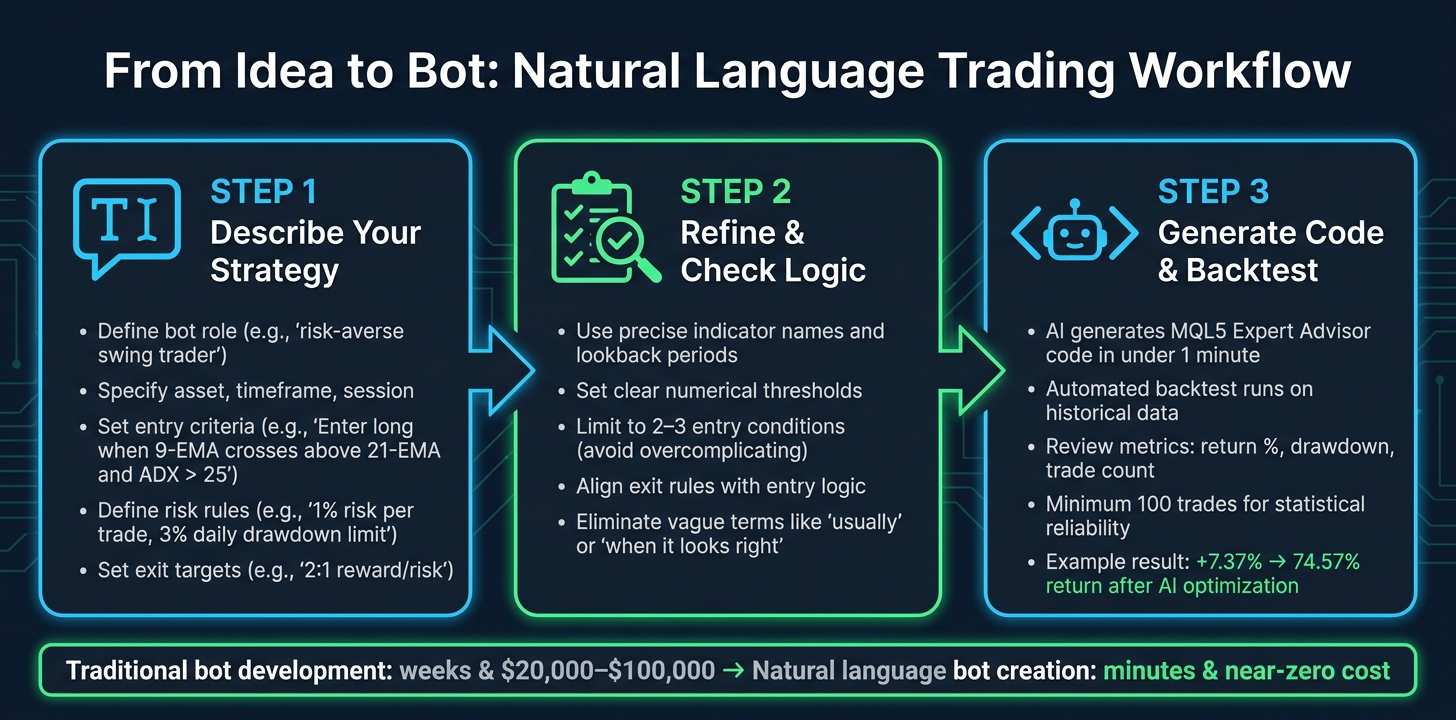
How to Build a Trading Bot with Natural Language Queries
Turning a trading idea into a functioning bot might sound complex, but it boils down to three straightforward steps: describe, refine, and generate.
Describing Your Strategy in Plain Language
To create an effective trading bot, you need a structured and detailed description - not vague, one-off questions like "Should I buy EUR/USD now?" Instead, think of it as writing clear, persistent instructions that define exactly how the bot should operate.
A good description includes six key elements: the bot's role (e.g., "You are a risk-averse swing trader"), the market context (asset, timeframe, session), entry criteria, risk rules, exit targets, and the output format. Here's an example:
"Trade EUR/USD on the 15-minute chart during the London session. Enter long when price closes above the 20 EMA and RSI is between 45 and 65. Risk 1% per trade with a 3% daily drawdown limit. Take profit at 2:1 reward/risk." This level of clarity ensures the bot knows exactly what to do.
"The difference? The system prompt. Your prompt literally IS your AI trading strategy." - Diego Arribas Lopez, Trader and AI Specialist
This step sets the foundation for reviewing and refining your strategy.
Refining and Checking Strategy Logic
Once you've drafted your strategy, the next step is to rigorously check its logic. Every rule must be precise and executable by a machine - no room for vague terms like "usually" or "when it looks right".
Each condition should specify the exact indicator, its lookback period, and clear numerical thresholds. For example, instead of piling on eight indicators, aim for two or three well-defined entry conditions. Overcomplicating your strategy can make it fragile in live markets. Also, ensure your exit rules align with your entry logic. Pairing trend-following entries with tight fixed profit targets, for instance, creates a mismatch that can negatively impact performance.
"A rule that cannot be stated precisely cannot be coded. A rule that cannot be coded cannot be backtested." - Quanthop
This refinement process is crucial before moving on to coding and testing.
Generating and Testing MQL5 Code
Platforms like Traidies can take your natural language description and generate MQL5 code in less than a minute. From there, you can quickly backtest and optimize your strategy. For instance, in March 2026, developer Ntale Geofrey used this approach to create a MACD-RSI momentum strategy for SNPS on a daily timeframe. After just one round of AI-driven optimization, the strategy's return jumped from +7.37% to an impressive 74.57%, with a maximum drawdown of only 8.18%.
"The value of a tool like this isn't that it finds winning strategies for you. It's that it makes the process of testing fast enough that you can develop real judgment rather than running on belief and gut feeling alone." - Ntale Geofrey, Software Developer
When backtesting, remember this rule of thumb: use a sample of at least 100 trades to ensure the results are statistically reliable. Anything below 30 trades may not provide meaningful insights.
Following this workflow, you can confidently transform your trading idea into a backtested, automated strategy that's ready for live trading.
Traidies: Natural Language Trading in Practice
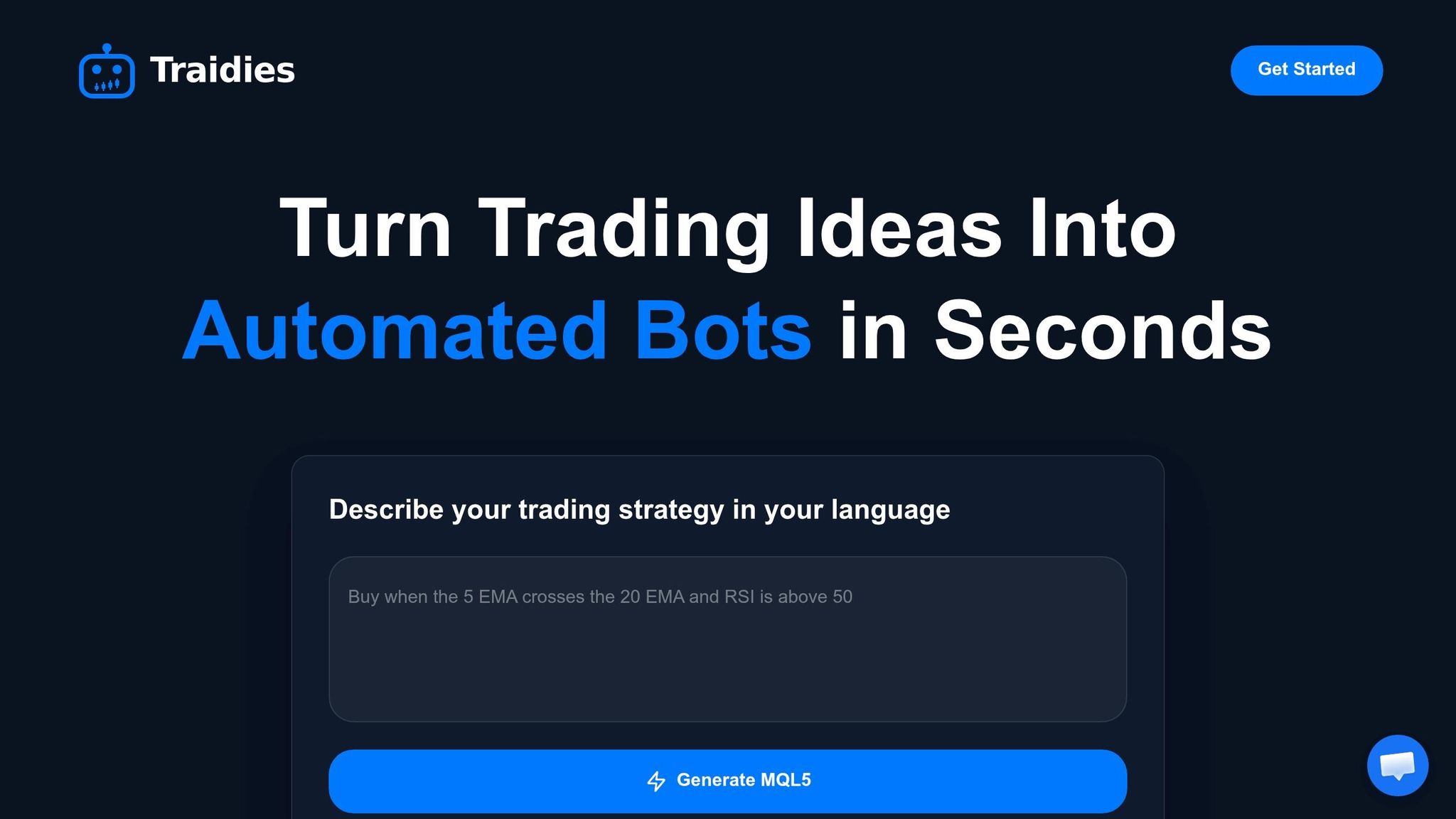
Traidies takes the concept of a streamlined design workflow and applies it to trading automation, making it accessible to anyone - even those without coding skills. With Traidies, you can create a trading bot by simply describing your strategy in plain English. The platform handles everything: interpreting your instructions, generating the necessary code, and even testing your strategy.
AI Strategy Parser
The AI Strategy Parser is the heart of Traidies' simplicity. When you describe your trading strategy, the parser breaks it down into structured components by identifying your intent and translating it into specific Strategy, Action, and Condition objects. For instance, if you input something like, "If price crosses above the 20-day moving average and volume is above average, buy 2% of portfolio," the parser automatically converts this into executable trading logic - no coding required.
Instant MQL5 Code Generation
Once your strategy is structured, Traidies generates a fully functional MQL5 Expert Advisor file for MetaTrader. This eliminates the need for manual coding or troubleshooting, allowing you to focus on your strategy rather than the technical details.
Automated Backtesting with Historical Data
After generating the code, Traidies takes it a step further by conducting an automated backtest using historical market data. There's no need for manual setup - Traidies handles it all. The backtest provides key performance metrics, such as return percentage, drawdown, and trade count. These insights help you decide whether your strategy is ready for live trading or needs further tweaking.
Benefits and Limitations of Natural Language Queries
Benefits of Using Natural Language Queries
One of the biggest advantages of natural language queries is how accessible they make algorithmic trading. Historically, trading algorithms were the domain of professionals with advanced coding skills and the patience to handle complex setups. Now, those barriers are disappearing. As Benjamin Rollert, CEO of Composer, explains:
"AI is reshaping markets in ways that mirror the transition from manual to electronic trading."
This shift allows traders to focus on strategy rather than technical hurdles. A single, well-crafted sentence can now define an entire trading strategy, eliminating hours - or even weeks - of manual coding. Speed is another game-changer. With natural language queries, traders can quickly test ideas, discard weak ones, and refine promising strategies in minutes, all before putting any actual money at risk.
While these benefits are impressive, there are also challenges to keep in mind.
Limitations and Considerations
Natural language queries, for all their advantages, come with some notable constraints. The most significant challenge is ambiguity. Human language is inherently imprecise, and vague queries often lead to flawed logic. Diego Arribas Lopez, a trader and author, summed it up well:
"Vague prompts create vague trades. Specific prompts create specific profits."
Another issue is overfitting - a common pitfall where strategies perform well in backtesting but fail in real-world trading conditions. Additionally, natural language bots lack the ability to adapt to changing market conditions unless explicitly programmed to do so.
| Factor | Key Considerations |
|---|---|
| Ambiguity | Unclear queries lead to misinterpreted logic |
| Overfitting | Backtested success may not hold in live markets |
| Market regime shifts | Sudden volatility can disrupt fixed-rule strategies |
| Technical failures | API downtime or connectivity issues can impact execution |
The key to navigating these challenges lies in clarity and preparation. Be as precise as possible when crafting your queries, rigorously backtest your strategies, and treat early deployments as simulations rather than live trades. As Bastien Capodagli, a portfolio manager, puts it:
"AI accelerates the development and testing of trading logic; however, if the underlying idea is weak, no amount of speed will yield success."
Conclusion: Building Trading Bots with Natural Language
Thanks to the streamlined workflows and AI-powered tools discussed earlier, creating a trading bot is now faster and more accessible than ever. What used to take weeks of coding and debugging can now be accomplished in just minutes. As Freelance Developer Fracabu aptly put it:
"Today one sentence and you have the bot. AI changed everything."
The transformation isn't just about speed - it's about accessibility. By using natural language queries, algorithmic trading is no longer limited to those with programming expertise. Now, anyone with a clear strategy can participate, leaving the technical complexities to the system while focusing on refining their ideas.
Take Traidies as an example. This platform lets users describe their trading strategy in simple English, instantly generates MQL5 code, and even tests the strategy against historical data - all before any real money is on the line. However, success still hinges on having a well-thought-out plan. Clear and precise strategies remain the foundation of effective trading.
Natural language trading doesn't replace the need for solid strategies - it simply makes the journey from idea to execution much faster.
FAQs
How detailed should my strategy prompt be?
When setting up a trading bot, specificity is your best friend. A clear and detailed prompt ensures the AI understands your trading objectives and executes them effectively. Here's what to include:
- Asset names: Specify the exact assets or markets you're targeting (e.g., "trade Bitcoin and Ethereum" or "focus on S&P 500 stocks").
- Time frames: Define the time frame for analysis and trading (e.g., "use 1-hour candlesticks" or "analyze daily trends").
- Risk management rules: Outline your approach to risk, such as stop-loss levels, position sizes, or maximum drawdown limits.
- Desired outcomes: Be explicit about your goals - whether it's maximizing short-term gains, minimizing risk, or achieving steady long-term growth.
Avoid vague instructions like "make profitable trades" or "follow market trends." Instead, aim for precision. For example, instead of saying, "trade stocks", you might say, "focus on tech stocks with a market cap above $10 billion, using a 15-minute chart for entry signals based on RSI and MACD indicators."
The more detail you provide, the better the AI can align with your trading goals and deliver meaningful results.
How do I avoid overfitting when backtesting?
To reduce the risk of overfitting during backtesting, it's smart to limit the number of parameters in your strategy. Instead of zeroing in on the "perfect" value, focus on broader ranges. Keep signals and filters distinct, and make sure to consider the number of trades your strategy generates - too few trades might indicate over-optimization. Splitting your test period into separate segments can help confirm the strategy's reliability. Additionally, analyzing various patterns can ensure your strategy isn't overly tailored to past data, making it more likely to perform effectively in both backtesting and live trading.
What happens if the bot misreads my instructions?
If the trading bot misunderstands your instructions, it could execute trades or strategies that don't align with your goals, leading to potential financial losses or unexpected outcomes. To reduce this risk, focus on providing clear and precise prompts. Additionally, take the time to thoroughly test your strategies. By crafting well-thought-out instructions and conducting comprehensive backtesting, you can help ensure the bot operates as intended and stays aligned with your trading objectives.