5 Ways NLP Improves Risk Analysis in Trading
5 Ways NLP Improves Risk Analysis in Trading
Natural Language Processing (NLP) is transforming risk analysis in trading by analyzing unstructured data - like news, social media, and regulatory documents - at speeds and scales humans can’t match. Here's how it helps:
- Sentiment Analysis: Scans thousands of news and social media sources in real-time, detecting market sentiment shifts hours before price changes.
- Document Risk Flagging: Quickly identifies risks in contracts and filings, reducing review time by 90% and increasing accuracy.
- Anomaly Detection: Spots irregularities in financial texts that hint at risks before they appear in prices or reports.
- Credit/Portfolio Risk Assessment: Processes vast data to identify early credit risks, improving accuracy by up to 40%.
- Predictive Insights: Uses subtle language cues to anticipate market stress scenarios, enabling better preparation.
These tools save time, cut costs, and improve decision-making for traders and institutions. For example, one bank detected 37% more fraud and prevented $15 million in losses within six months of adopting NLP.
Use cases of Natural Language Processing in Trading | Terry Benzschawel
sbb-itb-3b27815
1. Real-Time Sentiment Analysis from News and Social Media
Natural Language Processing (NLP) systems can scan thousands of sources every minute to identify shifts in market sentiment. This process involves three key steps: text preprocessing (organizing and cleaning data), feature extraction (analyzing word choice, sentence structure, and intensity), and classification (assigning a sentiment score, typically between -1 and +1).
Improves Risk Detection Speed
While a human analyst might handle 50–100 articles daily, NLP algorithms can process over 10,000 news headlines per minute. As Pietro Di Lernia highlights:
"A human can read 50-100 articles per day. A sentiment analysis algorithm can analyze 10,000+ news headlines per minute, covering global sources in real time."
This speed creates a critical advantage for managing risks. For instance, negative sentiment spikes on social media often occur 2–6 hours before actual price drops, giving traders an opportunity to adjust their positions. During the 2021 GameStop surge, NLP systems revealed that tweet volumes surged 30–60 minutes ahead of trading activity, offering traders a meaningful head start. Such rapid detection enables more effective risk management strategies.
Enhances Risk Mitigation Accuracy
Advanced transformer models like FinBERT outperform simpler systems like VADER, achieving an accuracy rate of 85–92% compared to VADER's 65–72%. This is largely due to their ability to understand context more effectively. For example, a 2023 study analyzing 100,000 earnings call transcripts found that negative sentiment in management commentary predicted a 3–5% stock underperformance over the following quarter. Additionally, a one-standard-deviation drop in sentiment during an earnings call was linked to a 2.8% decline in stock price over the next 30 days.
Supports Automation in Trading
NLP systems convert unstructured text into numerical scores, which automated trading systems can directly use. Many traders employ a "cascade approach" to optimize both speed and accuracy. Fast, lexicon-based models like VADER filter out neutral content, leaving more complex analysis to transformer models like FinBERT. This approach reduces computational demands by 70% while maintaining accuracy. Sentiment scores are often normalized using z-scores to highlight unusual shifts that signal emerging risks . Platforms like Traidies simplify this process by turning natural language inputs into executable trading code.
Reduces Operational Costs
Automating sentiment analysis removes the need for manually reviewing thousands of documents. The cascade approach is particularly cost-efficient, using VADER for quick screenings and reserving FinBERT for more complex tasks like analyzing SEC filings. Cloud-based systems supporting FinBERT typically cost $50–$100 per month, while institutional-grade real-time feeds range between $2,000 and $10,000 per month.
These advancements showcase how NLP-driven sentiment analysis offers a fundamentally different approach to risk management compared to traditional methods - something we'll delve into further in the article.
2. Contract and Regulatory Document Risk Flagging
Businesses handle thousands of contracts and regulatory filings every quarter. NLP systems can scan these documents in mere seconds, identifying risks that manual reviewers might overlook. By extracting critical details - such as payment schedules, renewal dates, penalties, and obligations - NLP highlights high-risk clauses like unlimited liability, unfavorable payment terms, or unnoticed auto-renewals.
Speeds Up Risk Detection
Manually reviewing a single contract typically takes around 90 minutes. In contrast, NLP systems can complete the same task in about 3 minutes. This efficiency is even more apparent for regulatory filings. While traditional compliance teams may monitor 20 high-priority companies, NLP systems can actively track 500+ companies at once, cutting contract review time by 90%. By turning dense legal data into clear risk indicators, NLP equips traders to act swiftly, often before risks escalate.
Boosts Risk Mitigation Accuracy
NLP systems deliver over 95% accuracy when extracting data from financial documents. Using Named Entity Recognition (NER), they pinpoint specific entities like monetary amounts, jurisdictions, and signatories, ensuring no critical details are missed. Organizations adopting NLP report a 60% improvement in identifying risks from regulatory filings. For instance, a leading insurance company implemented an NLP tool to analyze claim descriptions and adjustor notes between 2024 and 2025, achieving a 29% improvement in fraud detection accuracy and saving $8.3 million annually. This level of precision also supports seamless integration with automated trading systems.
Enables Automation in Trading
NLP transforms unstructured legal language into structured, actionable data that trading algorithms can directly use. For example, it scans 10-Ks, 10-Qs, and 8-Ks to categorize risk disclosures, tracking emerging or escalating risks like cybersecurity breaches, supply chain issues, or geopolitical tensions. Traders can link NLP-generated risk flags to automated systems that trigger "sell" or "hedge" orders when material risks - like a sudden CFO resignation or new litigation - are detected in 8-K filings. Tools like Traidies make this possible by converting natural language strategies into executable trading code.
Cuts Operational Costs
NLP doesn’t just improve speed - it also slashes costs. Manual document processing costs about $12 per document, while NLP reduces this to just $1.80. Additionally, automated data extraction significantly lowers error rates from 5% to 0.2%, minimizing costly mistakes and the need for rework. The most effective approach combines automation with human oversight: NLP handles 80% of high-confidence extractions, while the remaining 20% of complex cases are reviewed by humans, ensuring both efficiency and accuracy.
3. Anomaly Detection in Financial Time Series and Reports
NLP has become a powerful tool for spotting subtle anomalies in financial texts, often identifying risks before they show up in price charts or financial statements. By building on sentiment analysis and document review, NLP can now detect nuanced irregularities that may signal upcoming market changes. While real-time sentiment analysis focuses on immediate signals, anomaly detection zeroes in on the small deviations that often precede larger shifts.
Improves Risk Detection Speed
Modern NLP systems can process market-relevant signals almost instantly, which is crucial since text-based cues lose their relevance quickly. For example, transformer-based models like FinBERT can analyze complex documents like 10-K filings in just seconds using a single GPU - tasks that would take human analysts days to complete. These systems scan thousands of documents simultaneously, identifying patterns and subtle irregularities that humans might overlook or take weeks to piece together.
Enhances Risk Mitigation Accuracy
Advanced tools like FinBERT classify sentiment with an accuracy rate of 85%–97%, significantly outperforming traditional methods that average around 70%. This level of precision is vital because about 75% of words flagged as "negative" by generic sentiment tools are actually neutral in financial contexts. In 2025, a credit card issuer implemented NLP to monitor merchant descriptions and customer interactions, leading to 45% faster detection of compromised accounts and a 31% drop in fraudulent transactions. By identifying linguistic cues like urgency, pressure, or deception, NLP catches anomalies that structured data analysis often misses. It can even flag inconsistencies between documents, such as when a CEO's tone in an earnings call Q&A deviates from their usual phrasing - often hinting at financial trouble before official reports confirm it.
Supports Automation in Trading
NLP also integrates smoothly with automated trading systems, enabling real-time responses. By converting text into vectors that highlight deviations from norms, unsupervised learning models can detect significant departures from expected patterns. Since risk signals from text tend to decay within 1 to 5 days for earnings calls and 10-K filings, automated trading strategies must act quickly to capitalize on the information before markets adjust. Platforms like Traidies make this possible by transforming NLP-generated anomaly signals into executable trading code, allowing traders to respond automatically without manual input.
Reduces Operational Costs
NLP-driven automation offers significant savings by cutting down on manual investigation time. For example, a major insurance company introduced an NLP solution in 2025 to analyze claim descriptions and adjustor notes. This led to a 29% improvement in fraud detection accuracy, a 22% reduction in investigation time, and $8.3 million in annual savings. Similarly, a global investment bank reduced false positives by 42%, significantly lowering labor costs for investigations. Many production systems now use a tiered approach: fast FinBERT screening processes large datasets, while deeper LLM analysis focuses only on high-priority anomalies. This approach balances cost efficiency with accuracy, eliminating the need for proportional increases in staff.
4. Better Credit and Portfolio Risk Assessment
Expanding on earlier uses of NLP for detecting risks and identifying anomalies, its application in credit and portfolio risk assessment offers financial institutions a proactive way to manage risk. By analyzing vast amounts of unstructured data - like regulatory filings, news reports, social media posts, and internal documents - NLP enables a more comprehensive understanding of potential risks. This approach shifts institutions away from relying solely on traditional metrics like credit scores and balance sheets, allowing them to identify potential problems early and act swiftly.
Speeds Up Risk Detection
NLP systems can process credit-related data at astonishing speeds, cutting review times from days to mere minutes. Real-time analysis of news allows institutions to quickly spot critical developments, such as executive scandals or sudden market changes. Tools like Named Entity Recognition (NER) extract important details - like company names, monetary amounts, or dates - from unstructured text, enabling institutions to gather and analyze risk factors across massive datasets almost instantly. These capabilities provide the foundation for faster, more accurate risk evaluations.
Improves Risk Mitigation Accuracy
NLP models such as BERT, RoBERTa, and FinBERT excel at capturing the nuances in complex financial data, helping institutions reduce credit losses by as much as 20–40%. For example, hybrid CNN-Transformer architectures have achieved accuracy rates of up to 96.9%, with F1-scores of 0.955, while attention-based LSTM models report AUC improvements of 3.08% and KS increases of 10.3%. Event extraction methods further enhance risk mitigation by flagging critical corporate events - like leadership changes, acquisitions, or legal disputes - before these risks are reflected in conventional metrics.
Enables Automation in Trading
With these advanced risk assessments, automated trading systems can now respond to risks in real time. NLP-driven tools extract financial metrics and disclosures from unstructured data, replacing manual processes that are often error-prone. Modern trading platforms process enormous amounts of data daily, using it to generate alpha while mitigating risks. For instance, platforms like Traidies allow traders to describe risk management strategies in natural language, which are then converted into automated bots capable of responding instantly. This automation frees up human resources for higher-value tasks, such as developing and executing trading strategies.
Cuts Operational Costs
NLP-powered automation delivers substantial financial savings. For example, one insurance company saved $8.3 million annually by implementing an NLP-based risk analysis system. Similarly, a global investment bank prevented $15 million in fraudulent transactions within six months while reducing false positives by 42% and cutting investigation times by 22%. McKinsey & Company highlights the potential for even greater savings:
"Automation technologies, including NLP and NLG, have the potential to reduce operational costs by up to 90%"
These savings come from eliminating time-consuming manual reviews, reducing false alarms, and addressing risks early - when they are less costly to manage.
5. Predictive Insights for Scenario Analysis and Stress Testing
Natural Language Processing (NLP) is changing how trading systems prepare for market turbulence by turning qualitative signals into measurable forecasts. Instead of focusing solely on immediate sentiment shifts, these predictive models look ahead, helping to anticipate potential stress scenarios. By going beyond historical numerical data, NLP examines subtle cues like management tone during earnings calls, pauses in executive speech, and sentiment trends in news coverage. This helps identify early warning signs and potential risks that traditional models might overlook.
These advancements build on earlier methods, refining scenario analysis and stress testing. NLP doesn’t just monitor real-time events - it equips traders to foresee market downturns and prepare in advance.
Improves Risk Detection Speed
NLP systems excel at processing text data in real time, continuously scanning global news and regulatory updates with minimal delay. This near-instantaneous processing allows traders to adjust and model potential stress scenarios as events unfold. The ability to test multiple scenarios across various risk factors simultaneously gives traders a critical speed advantage, especially in volatile markets.
Enhances Risk Mitigation Accuracy
By drawing insights from diverse sources, such as regulatory filings and social media, NLP uncovers hidden patterns that contribute to a more complete risk picture. It’s particularly effective at identifying risks like geopolitical tensions (e.g., trade disputes), credit issues stemming from borrower challenges, or reputational threats. These insights enable traders to model scenarios more accurately and prepare for extreme events that might escape traditional quantitative models.
Supports Automation in Trading
NLP transforms unstructured data - like trader chat logs, audio recordings, and earnings transcripts - into structured formats that power automated trading systems. These insights allow trading algorithms to adjust positions proactively based on predicted scenarios, rather than reacting after the fact. For example, platforms like Traidies let traders describe risk strategies in natural language, which are then converted into automated trading bots. This integration of NLP streamlines trading processes and strengthens risk management.
Reduces Operational Costs
By automating scenario analysis, NLP eliminates the need for manual stress testing across multiple risk factors. This automation drastically cuts down the time and resources required to assess portfolio resilience. With predictive insights generated automatically, institutions can conduct frequent and thorough stress tests at a fraction of the cost, catching vulnerabilities early - when addressing them is less expensive.
Comparison: Traditional vs. NLP-Based Risk Analysis
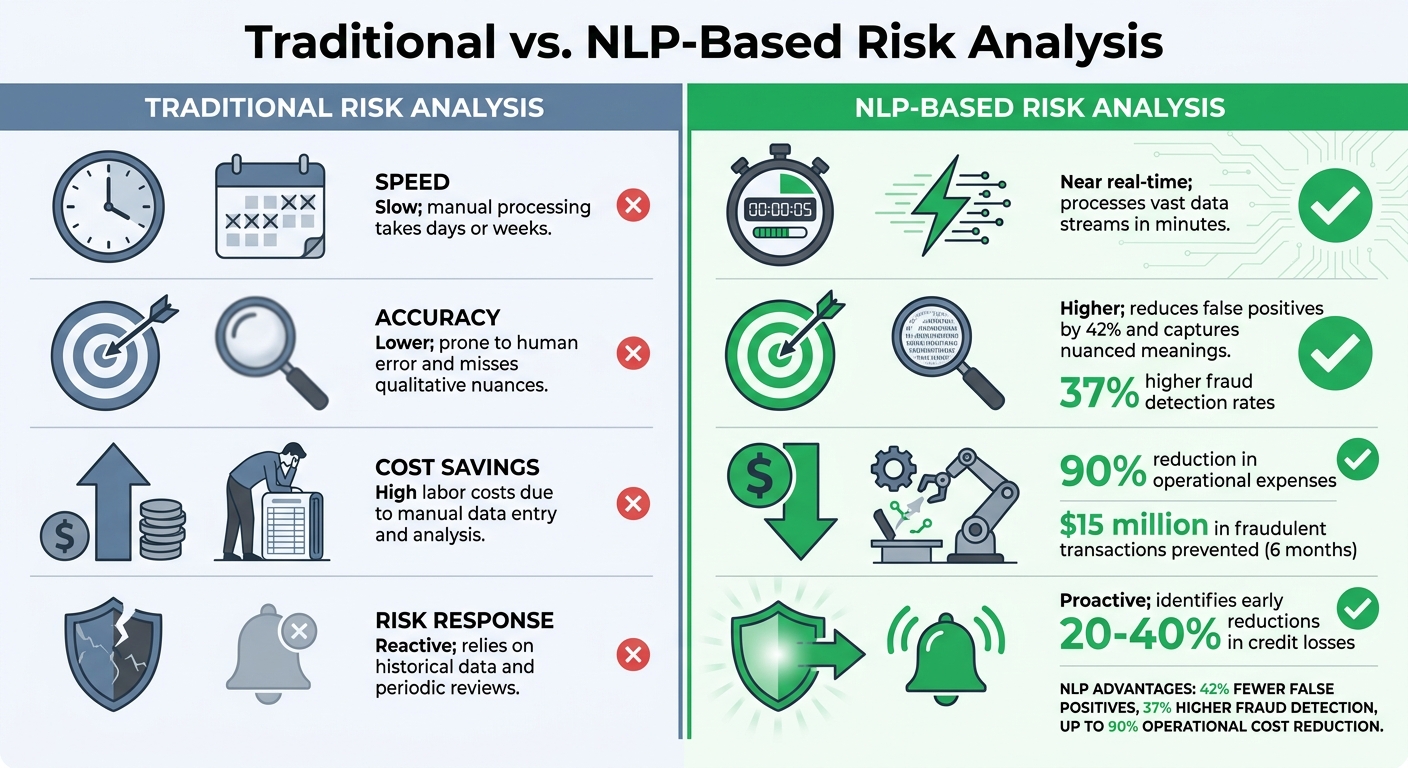
Traditional vs NLP-Based Risk Analysis in Trading: Speed, Accuracy, and Cost Comparison
The gap between traditional and NLP-based risk analysis is striking. While traditional methods depend on structured data like balance sheets and market prices, NLP-based approaches tap into unstructured data sources such as news articles, social media posts, and regulatory filings . This shift has reshaped the way risks are assessed.
One of the most noticeable differences is speed. Traditional methods require manual processing, often taking days or even weeks to evaluate industry sector exposures. In contrast, NLP systems can complete these tasks in a matter of minutes or hours. For instance, one bank implemented an NLP system that not only outpaced manual analysis but also significantly improved fraud detection, reducing losses.
Accuracy is another area where NLP shines. Traditional approaches are prone to human error and often miss the subtle qualitative information embedded in text. A major insurance company, for example, introduced an NLP solution between 2024 and 2025 to analyze adjustor notes and claimant communications. The result? A 29% boost in fraud detection accuracy and a 22% reduction in investigation time, leading to $8.3 million in annual savings.
| Method | Speed | Accuracy | Cost Savings | Risk Response |
|---|---|---|---|---|
| Traditional | Slow; manual processing takes days or weeks | Lower; prone to human error and misses qualitative nuances | High labor costs due to manual data entry and analysis | Reactive; relies on historical data and periodic reviews |
| NLP-Based | Near real-time; processes vast data streams in minutes | Higher; reduces false positives by 42% and captures nuanced meanings | Significant; automates high-volume tasks and prevents fraud losses | Proactive; identifies early warning signals and emerging threats |
These distinctions highlight how NLP not only speeds up analysis but also strengthens risk management overall.
NLP-based systems represent a shift from reacting to risks after they occur to proactively identifying potential threats. As mentioned earlier, these systems excel at automating labor-heavy tasks while spotting risks before they escalate. Sarah Lee, an AI researcher, captures this evolution well:
"NLP now offers sophisticated tools to extract, analyze, and act upon textual data with remarkable accuracy and efficiency"
This capability enables trading systems and other industries to address risks early, preventing losses before they happen.
Conclusion
NLP has reshaped how risk analysis is approached in trading, offering rapid processing of unstructured data from sources like news feeds, social media, and regulatory documents - areas where traditional methods often fall short. The results speak for themselves: institutions using NLP have reported 37% higher fraud detection rates and 42% fewer false positives. One notable example is a global investment bank that stopped $15 million in fraudulent transactions within just six months of implementing NLP in March 2025.
By automating time-consuming tasks such as document review and sentiment analysis, NLP drastically cuts costs - up to 90% in operational expenses. In credit risk assessment, companies have experienced 20–40% reductions in credit losses. On a broader scale, NLP is expected to add $15.7 trillion to the global economy by 2030, streamlining processes and enhancing decision-making across industries.
Tools like Traidies make adopting NLP-driven solutions straightforward. They eliminate technical hurdles, allowing traders to describe strategies in plain language while AI tools handle complex tasks like generating MQL5 code and conducting automated backtesting with historical data. This means traders can integrate sentiment analysis and risk assessment into their bots without needing advanced data science expertise.
Shifting from reactive to proactive risk management is now more crucial than ever in competitive trading. As Leo Mercanti aptly puts it:
"NLP is rapidly transforming the financial industry, enabling professionals to quickly process and act on unstructured data"
The real question isn't whether to embrace NLP-driven tools, but how fast you can implement them to stay ahead in today's fast-paced markets.
FAQs
What data sources should I feed into an NLP risk model?
To improve an NLP risk model, incorporate unstructured textual data from diverse sources like financial news, company reports, social media posts, regulatory filings, and internal documents. These materials provide valuable insights and can help identify early warning signs in trading risk analysis.
How do I validate NLP signals before using them in automated trading?
To ensure NLP signals are reliable, it's crucial to perform thorough backtesting and validation. Start by collecting relevant textual data, such as news articles or financial reports. Once gathered, clean and process this data to extract meaningful features, like sentiment scores. These signals can then be aggregated into metrics and tested against historical price data to assess their performance.
Next, calibrate models like VADER or BERT to refine their accuracy. Incorporate risk controls to account for any noise or unexpected market anomalies, ensuring the signals remain dependable in real-world scenarios.
What are the main compliance risks of using NLP in trading?
The main compliance risks associated with using NLP in trading revolve around the possibility of regulatory violations stemming from misinterpreted textual data. Since NLP tools process and analyze large volumes of text, inaccuracies in interpretation could lead to unintended actions or decisions that conflict with regulations.
Moreover, regulations in the trading industry are constantly evolving. This means NLP tools must be continuously monitored and updated to ensure they remain compliant. Neglecting this ongoing adjustment could expose firms to compliance breaches, which may result in penalties or other legal consequences.