How AI Enhances Compliance in Trading Bots

How AI Enhances Compliance in Trading Bots
Trading bots now dominate U.S. equity markets, handling up to 73% of trades. But with this growth comes heavy regulatory scrutiny. Since 2015, the SEC has issued over $300 million in fines for trading violations, with penalties topping $1.1 billion in 2022 alone for communication monitoring failures. Traditional compliance systems struggle to keep up, plagued by high false positives (85–95%) and slow, manual processes.
AI offers a solution. It enables real-time monitoring, cuts false positives by 40–60%, and streamlines compliance tasks. Tools like machine learning detect market abuse instantly, while NLP scans communications for risks. AI also ensures proper documentation, meeting stringent audit standards like FINRA Rules 3110 and 3120. Platforms such as Traidies integrate compliance safeguards directly into trading strategies, automating risk limits and regulatory checks.
Key takeaways:
- AI reduces compliance costs and errors. Financial crime compliance costs in the U.S. and Canada hit $61 billion, consuming 42% of executives’ time.
- Real-time oversight replaces periodic audits. AI analyzes every trade instantly, improving accuracy and transparency.
- AI adoption is growing. Use in anti-money laundering jumped from 42% in 2024 to 82% in 2025.
AI transforms compliance from a reactive task into a continuous process, helping firms avoid penalties and build trust in a highly regulated market.
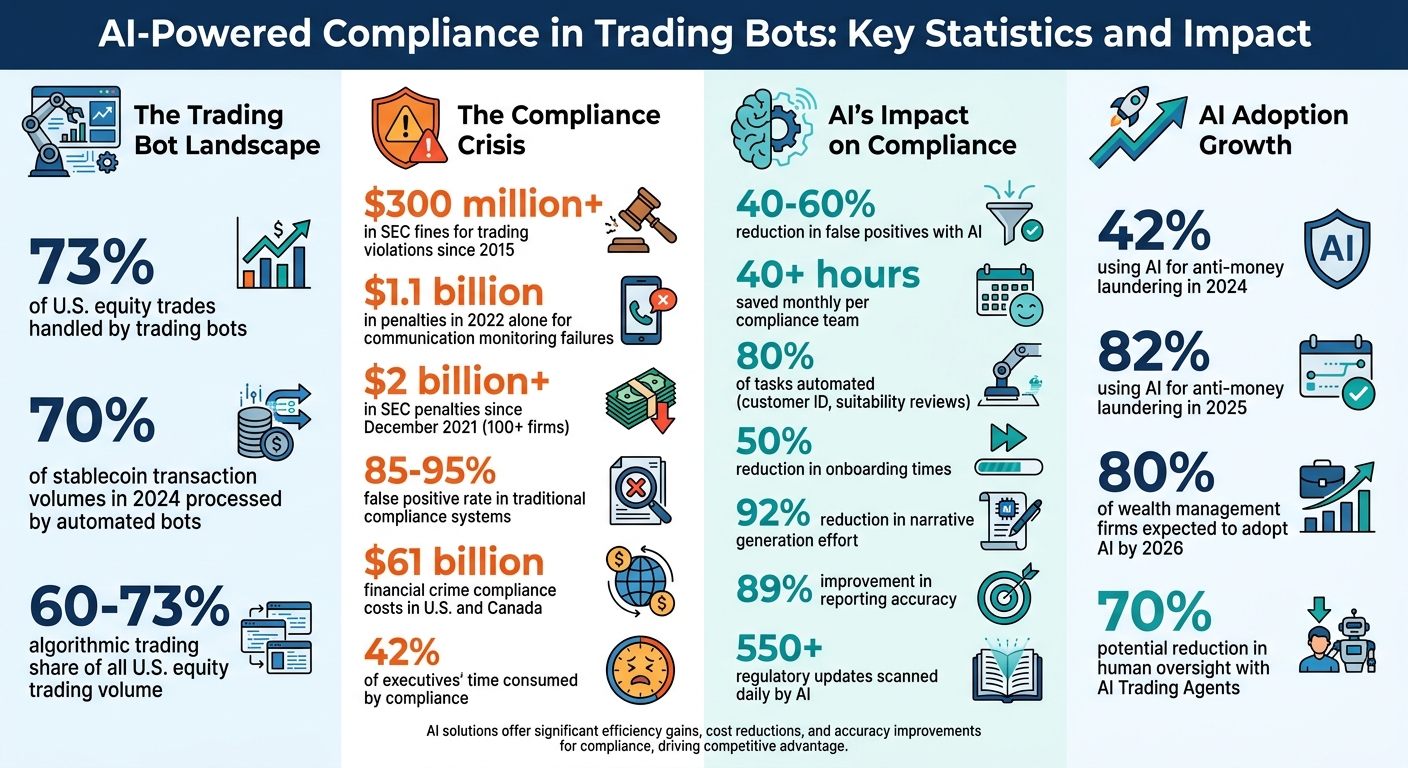
AI-Powered Compliance in Trading Bots: Key Statistics and Impact
Automate Regulatory Compliance with Advanced AI and MongoDB
sbb-itb-3b27815
Common Compliance Problems in Trading Bots
Trading bots operate at lightning-fast speeds, often processing transactions in milliseconds - far beyond human oversight capabilities. The sheer volume of data adds another layer of complexity. For example, in 2024, automated bots were responsible for about 70% of stablecoin transaction volumes across networks like Ethereum and Solana. No compliance team can manually keep up with activity on this scale, highlighting the growing reliance on AI-driven solutions to address these challenges.
Difficulty Detecting Market Abuse
A significant compliance issue is the challenge of identifying market abuse in high-frequency trading environments. Practices like wash trading, front-running, and spoofing require sophisticated AI systems for accurate detection. Regulations such as MiFID II now mandate audit trails with microsecond granularity - one-millionth of a second - synchronized to UTC, a level of precision manual records simply cannot achieve. Adding to the difficulty, black-box AI models often obscure the decision-making process, leaving compliance teams scrambling to justify actions after the fact instead of enabling real-time monitoring.
Manual Risk Limit Enforcement
Static risk parameters are another weak point, especially during periods of high market volatility. Manual adjustments are too slow to prevent errors like "fat finger" trades or rapid capital losses. For instance, during volatile market conditions, delays in updating drawdown limits or leverage caps can turn manageable losses into major financial disasters. In early 2025, Two Sigma and Interactive Brokers faced hefty fines after algorithmic changes bypassed internal controls, exposing vulnerabilities in their monitoring and documentation processes. This case serves as a reminder: regulators won’t overlook the gaps created by manual enforcement.
Insufficient Documentation for Regulatory Audits
Compliance challenges extend beyond execution and risk management - maintaining thorough documentation is just as critical. Missing details like order-level timestamps, prices, quantities, and algorithm IDs make it nearly impossible for regulators to reconstruct trades. Without these records, firms cannot demonstrate that their supervisory systems meet the "reasonably designed" standard required under FINRA Rules 3110 and 3120. In 2024, Brex Treasury faced heavy penalties for poor recordkeeping tied to its identity-verification algorithm, proving that outsourcing AI functions doesn’t absolve firms of compliance responsibility. Gaps in logging signal inputs, quote snapshots, and model versions create audit trail deficiencies that can lead to sanctions - even in the absence of actual trading violations. For example, failure to maintain proper version control can leave firms unable to determine which algorithm version executed a specific trade, putting them in the precarious position of defending decisions they cannot fully explain.
How AI Improves Compliance Monitoring
AI has completely changed the game when it comes to compliance monitoring. Instead of reacting to issues after they arise, AI allows companies to stay ahead of potential problems. By using machine learning, suspicious patterns can be flagged instantly, ensuring round-the-clock oversight. Traditional compliance methods, which relied on sampling just a small portion of transactions, have been replaced by AI systems capable of analyzing every single trade in real time. This constant monitoring strengthens risk controls and creates a more transparent system for recordkeeping.
This shift directly addresses the delays and inaccuracies often seen in manual compliance processes.
Real-Time Anomaly Detection
Machine learning is particularly effective at spotting subtle irregularities that could indicate market abuse. By combining historical data with live trading activity, these systems can quickly identify behaviors like spoofing, layering, or insider trading. Unlike static rule-based systems, AI adapts to current market conditions, performing real-time risk assessments. For example, it can automatically adjust price limits or trade quantities based on shifts in market volatility and liquidity. When volatility spikes, the system reacts instantly, tightening controls to prevent errors that humans might overlook. It integrates data from multiple sources - such as trade patterns, volume changes, and timing discrepancies - into a single risk score. If thresholds are exceeded, alerts are triggered immediately.
Automated Logging and Decision Transparency
Regulators don’t just want correct decisions - they want proof of how those decisions were made. Modern AI systems provide detailed "why-trails", linking every trade to specific policy rules, data points, and evidence. These records are stored immutably using WORM (Write Once, Read Many) technology, ensuring they can’t be altered or deleted. The impact is striking: AI-driven reporting tools can cut the effort required for narrative generation by up to 92% and improve accuracy by as much as 89%. Explainable AI (XAI) tools further simplify this process by translating complex algorithmic decisions into plain language. This allows compliance officers to confidently explain and defend their decisions during audits without needing to interpret opaque machine logic.
Natural Language Processing for Compliance Signals
Natural Language Processing (NLP) takes compliance monitoring to another level by analyzing unstructured data sources that traditional systems often miss. These tools scan legislative updates, exchange notices, wire services, and even internal communications on platforms like Slack or Teams to identify risks such as insider trading or market manipulation. Unlike basic keyword searches, modern NLP understands context and intent, flagging nuanced issues like policy violations or fiduciary conflicts. This advanced approach has been shown to reduce false positives in conduct risk alerts by up to 500%. Additionally, trading bots leverage NLP to create "headline confidence scores" by combining information from news outlets, social media, and regulatory updates. When risks are detected, these bots can automatically pause trading or activate hedging strategies.
AI-Driven Risk Management for Compliance
AI isn’t just about monitoring compliance - it actively works to reduce compliance risks before they escalate. By 2026, regulatory frameworks in the U.S. and EU, such as MiFID II, have introduced stricter enforcement measures, including mandatory circuit breakers and detailed leverage disclosures for automated systems. AI-powered risk management tools meet these requirements by constantly adjusting trading parameters in real time. This ensures that automated systems remain within regulatory boundaries without the need for constant manual oversight.
This shift turns compliance from a reactive process into a dynamic, adaptive defense mechanism that evolves as quickly as the markets themselves. Below, we’ll explore how AI enforces risk limits, incorporates human oversight, and predicts compliance risks before they turn into violations.
Dynamic Risk Limit Enforcement
AI ensures compliance by automatically intercepting and adjusting trades before execution. For instance, AI systems like the "Shield" module modify orders to align with regulatory requirements, such as volume caps and dynamic risk limits. These systems adjust stop-loss thresholds and position sizes based on real-time market volatility. A common regulatory rule, for example, limits algorithms to executing no more than 10% of the market volume within any five-minute window to prevent manipulation.
When market volatility spikes, these protections tighten immediately. AI models, including those based on principles like the Kelly Criterion or Volatility Targeting, calculate optimal position sizes to ensure exposure remains within allowed limits.
Human-in-the-Loop Intervention
While AI excels at speed and precision, human oversight remains essential for accountability. Systems designed for compliance include manual override options that allow operators to halt AI functions during extreme anomalies or regulatory shocks. This ensures a balance between automation and human judgment.
Dual-authorization protocols add an extra layer of security. For example, increasing risk limits or overriding a bot’s defensive mechanisms requires approval from two authorized individuals. These measures align with 2026 audit standards, which mandate detailed logs of all interventions, complete with timestamps and justifications. As noted in FINRA's 2026 report:
"If a firm is relying on Gen AI tools as part of its supervisory system, its policies and procedures may consider the integrity, reliability and accuracy of the AI model."
Predictive Modeling for Risk Mitigation
AI doesn’t just react - it anticipates. Predictive models analyze regulatory trends, such as committee votes or delayed markups, to identify potential rule changes. When the system detects signs of regulatory shifts, it triggers defensive measures, such as halting trading or initiating hedging strategies.
Drift detection plays a critical role here. AI monitors when a bot’s performance or decision-making deviates from acceptable regulatory standards. If drift is detected, the system can initiate retraining or revert to previous configurations automatically. This proactive approach prevents gradual compliance failures that might go unnoticed by human reviewers. Notably, AI-driven fraud management platforms have demonstrated their effectiveness by reducing false positives by 40% to 60% compared to traditional rule-based systems. This allows compliance teams to focus on genuine risks rather than wasting time on irrelevant alerts.
Traidies: AI-Powered Compliance for Trading Bots
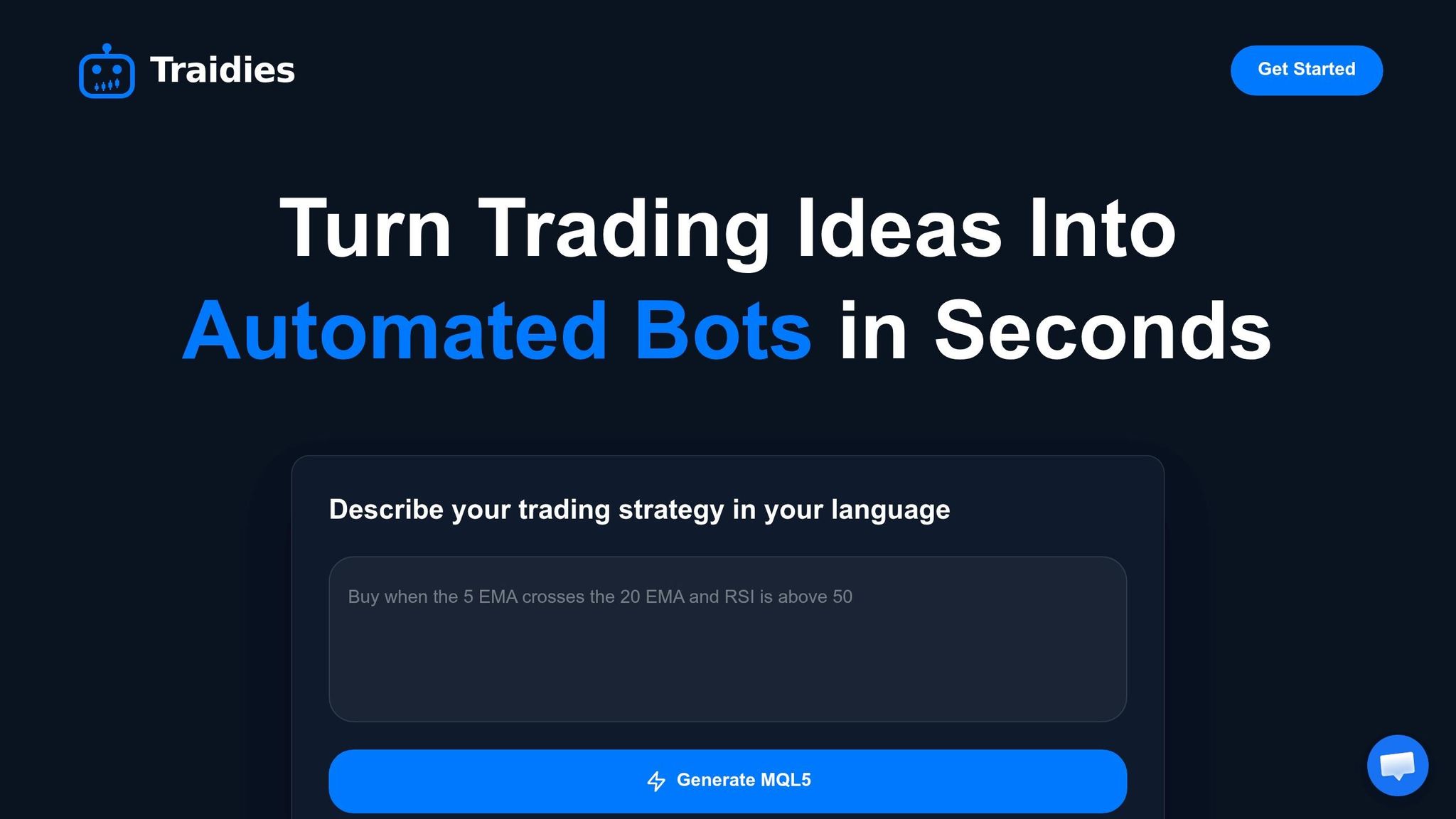
Traidies integrates AI safeguards into the bot creation process, embedding compliance measures from the very beginning of strategy development. This proactive approach directly addresses the compliance challenges faced by trading bots. Using its advanced AI tools, Traidies converts natural-language trading ideas into MQL5 code while automatically adding compliance parameters. Users can define risk limits, position constraints, and trading windows - all without needing to write complex code. The platform then generates Expert Advisors (EAs) that include pre-trade validation, blocking orders that breach restrictions like lot sizes, prohibited trading times, or maximum concurrent trades. By building compliance into every strategy, Traidies reinforces a commitment to regulatory integrity throughout the system.
AI Strategy Parser for Compliance Parameters
The AI Strategy Parser from Traidies takes external regulatory rules and translates them into internal code logic. For instance, if a user describes a strategy in plain language - such as "design a momentum strategy with a maximum position size of 5% of account equity" - the parser incorporates these constraints directly into the generated code. This eliminates the risk of missing critical regulatory requirements during manual coding. It ensures each trade is validated against predefined rules, such as margin requirements or position limits, rejecting any trade that doesn't comply. Unlike traditional compliance methods that monitor trades after execution, Traidies' parser ensures strategies are regulatory-compliant from the start by converting natural-language rules into executable MQL5 code.
Automated Backtesting with Compliance Simulations
Traidies' backtesting engine goes beyond performance metrics, simulating compliance scenarios that reflect real market conditions. It accounts for factors like margin calls, position limits, and mandatory kill switches to ensure strategies can handle regulatory constraints in live trading. For example, if a strategy recovers from a simulated 10% loss but would have been halted by a regulatory circuit breaker in real trading, the recovery is flagged as invalid. This approach prevents misleading results that ignore critical compliance factors. As the QuantStrategy.io team explains:
"A strategy that generates spectacular hypothetical returns but violates exchange rules or mandatory risk limits is not a profitable strategy - it is a broken model destined for regulatory penalties or sudden, catastrophic losses."
The backtesting simulations also produce detailed audit trails, documenting every compliance check for verifiable regulatory accountability. Additionally, Traidies uses these simulations to refine its Expert Advisors, ensuring they maintain compliance under all market conditions.
Customizable Expert Advisors for Compliance Needs
Traidies designs Expert Advisors tailored to enforce compliance rules automatically. These EAs continuously block orders that exceed lot sizes, violate trading time restrictions, or surpass maximum concurrent trade limits. Unlike manual oversight, which can be affected by emotions or fatigue, automated enforcement ensures compliance is maintained 24/7. Moreover, the platform guarantees that risk parameters remain intact even after system restarts, preventing bots from losing their compliance settings during technical interruptions. This ensures adherence to regulatory requirements, even in volatile markets.
Benefits of AI-Powered Compliance in Trading Bots
AI-powered compliance tools bring a host of advantages to trading operations, particularly in improving accuracy, efficiency, and transparency.
Better Accuracy and Fewer False Positives
Traditional rule-based compliance systems often struggle with high false positive rates, sometimes reaching 85–95%. This creates "alert fatigue", where compliance teams are overwhelmed by unnecessary alerts. AI-based surveillance, however, adapts to individual account behaviors, cutting false positives by up to 60%. This reduction translates into over 40 hours of saved time each month, allowing teams to focus on detecting serious violations like layering, spoofing, and front-running.
24/7 Monitoring and Efficiency Gains
AI compliance tools offer round-the-clock monitoring, something manual processes simply can't achieve. These systems automate up to 80% of tasks like customer identification and suitability reviews required by regulations such as FINRA Rule 4512 and Regulation Best Interest. Onboarding times can also be reduced by as much as 50%. Beyond that, automated archiving and logging enable firms to generate audit-ready records in seconds instead of days. AI-driven tools further enhance efficiency by scanning and summarizing over 550 regulatory updates daily. These capabilities not only streamline operations but also bolster real-time risk management.
Increased Transparency and Accountability
To address concerns around the opaque nature of AI, compliance systems now incorporate explainable AI (XAI) techniques. These provide clear decision rationales and confidence scores, which help compliance teams understand and audit automated decisions. FINRA emphasized the importance of such transparency in its 2026 Annual Regulatory Oversight Report:
"FINRA's rules... continue to apply when firms use GenAI or similar technologies in the course of their businesses, just as they apply when firms use any other technology or tool."
This level of documentation also strengthens accountability, creating a clear, verifiable record for regulators. Such meticulous recordkeeping is especially critical in light of the SEC's recent enforcement actions, where over 100 firms faced more than $2 billion in penalties for failures related to unmonitored communications since December 2021.
Conclusion
AI has reshaped compliance, turning it from a tedious, manual task into a dynamic, continuous process. By automating pattern detection, creating secure audit trails, and cutting false positives by 40–60%, AI tools directly tackle the challenges that have long hindered trading bot operations. Moving away from rigid, rule-based systems to intelligent monitoring systems now allows firms to process over 550 regulatory updates daily while maintaining round-the-clock surveillance - something manual efforts could never achieve.
Regulations are tightening, and the future demands more accountability. FINRA's 2026 Annual Regulatory Oversight Report signals a shift from offering guidance to enforcing strict accountability, treating AI as a critical part of a firm's supervisory framework. The rise of "AI Trading Agents" - systems capable of self-optimization and self-auditing - could reduce the need for human oversight by as much as 70%. At the same time, regulators are pushing for greater transparency through Explainable AI (XAI) frameworks. Chris Stanley, Founder of Beach Street Legal, aptly stated, "With great algorithmic power comes great regulatory responsibility".
The financial stakes make AI compliance non-negotiable. Since December 2021, the SEC has imposed over $2 billion in penalties on more than 100 firms for recordkeeping failures. With 80% of wealth management firms expecting to adopt AI by 2026 and algorithmic trading making up 60–73% of all U.S. equity trading volume, firms that weave compliance into their operational fabric - not as an afterthought but as a core function - will secure both regulatory protection and a competitive edge.
Regulators are clear: technology neutrality demands complete accountability. Whether decisions come from human traders or AI systems, firms are fully responsible for every outcome. Platforms like Traidies, which integrate AI compliance tools directly into strategy development and backtesting, are helping users meet these evolving standards while staying efficient. The future belongs to firms that treat compliance not as a burden, but as the cornerstone of sustainable and scalable growth.
FAQs
What data must a trading bot log to pass a SEC or FINRA audit?
Trading bots are required to maintain detailed logs of transaction records, audit trails, compliance-related communications, and model outputs. These logs play a crucial role in ensuring transparency and accountability while meeting the regulatory requirements set by SEC and FINRA. Proper record-keeping also simplifies audits and supports regulatory oversight processes.
How can AI reduce false positives without missing real market abuse?
AI helps reduce false positives and accurately detect real cases of market abuse through a combination of continuous performance monitoring, real-time feedback loops, and regular strategy reviews. These methods work together to pinpoint genuine anomalies while filtering out irrelevant alerts, maintaining both compliance and precision in the operations of trading bots.
How do you keep AI trading decisions explainable for regulators?
To make AI trading decisions clearer for regulators, several techniques come into play. Feature importance analysis highlights which factors the AI considers most influential in its decisions. Counterfactual explanations explore how outcomes would change if specific inputs were different, offering a "what-if" perspective. Lastly, model auditing involves systematically reviewing the AI to ensure it operates as intended. Together, these methods improve transparency and make it easier to meet compliance standards, while also addressing the risks associated with opaque, black-box models.