How AI Powers Dynamic Portfolio Rebalancing

How AI Powers Dynamic Portfolio Rebalancing
AI has transformed portfolio rebalancing, shifting from fixed schedules to real-time adjustments based on market conditions. This dynamic approach ensures portfolios maintain their target allocations even during volatile periods. Here's how AI makes it possible:
- Real-Time Adjustments: AI monitors portfolios continuously, triggering trades when assets deviate from set thresholds.
- Improved Accuracy: Machine learning analyzes market trends and volatility, optimizing rebalancing decisions.
- Emotion-Free Trading: AI eliminates biases, enforcing a disciplined approach to buying and selling.
- Cost Efficiency: Fewer trades and tax-loss harvesting reduce transaction costs and boost after-tax returns.
- Enhanced Performance: AI-driven strategies have shown lower volatility, higher returns, and better risk management.
AI tools like predictive analytics, machine learning, and natural language processing streamline these processes, offering traders precision, speed, and efficiency. Whether managing traditional assets or cryptocurrencies, AI helps achieve better outcomes with less effort.
Inside a Robo-Advisor: How AI Creates the Perfect Investment Portfolio
sbb-itb-3b27815
How AI Powers the Rebalancing Process
AI has reshaped portfolio rebalancing, turning it into a precise, data-driven operation. By leveraging real-time market data, AI systems adjust portfolios dynamically, something manual methods can’t achieve at the same scale or speed. The technologies driving this transformation - machine learning, predictive analytics, and natural language processing - work together to process massive datasets and execute trades with unmatched accuracy. Let’s break down how these tools are making a difference.
Machine Learning for Smarter Decisions
Machine learning (ML) thrives at uncovering patterns in complex datasets that humans might miss. It analyzes price trends, trading volumes, and macroeconomic indicators, identifying subtle market signals and trends. Unlike traditional static rules, ML models adapt continuously, learning from both historical and live data to refine strategies as markets shift.
A standout application is dynamic drift detection. For example, Random Forest regressors use inputs like volatility, trading volume, and bid-ask spreads to estimate tolerance bands. During calm markets, these bands widen to reduce unnecessary trades, while they tighten during volatile periods to maintain tighter risk control. Hidden Markov Models (HMMs) add another layer by detecting market "regimes" - like bullish trends versus high-volatility bear markets - and adjusting rebalancing frequency accordingly.
Machine learning also removes emotional biases from the equation. It provides data-driven assessments, reducing errors like procrastination or emotional attachment to specific assets. It can even identify overlapping exposures across accounts.
Real-world examples show how effective this can be. In 2023, PanAgora Asset Management began using large language models to analyze vast datasets, including macroeconomic indicators, to adjust asset allocations dynamically and manage risk. Similarly, Man Group employs ML algorithms to monitor market data in real time, automating rebalancing to keep portfolios aligned with risk-return goals.
Building on these capabilities, predictive analytics takes timing and cost efficiency to the next level.
Predictive Analytics and Market Forecasting
Predictive analytics helps AI forecast market trends and volatility with precision. Ensemble models, which combine techniques like Gradient Boosting, Long Short-Term Memory (LSTM) networks, and Convolutional Neural Networks (CNNs), generate reliable asset return forecasts for mean-variance optimization. These forecasts allow the system to anticipate market shifts instead of merely reacting to them.
Regime detection plays a key role here too. By identifying whether the market is in a "Bull Trend" or "Bear Volatility" phase, the system adjusts rebalancing frequency - ramping it up during turbulence and slowing it down during calmer times. This adaptive approach has proven highly effective. Backtests show that regime-aware ML models can achieve a Sharpe Ratio of 1.9, compared to 0.8 for static allocation strategies.
Some systems go even further by using regression models like LightGBM to analyze limit order book metrics. These models forecast market impact and slippage, ensuring trades are executed at the lowest possible cost.
Natural Language Processing for Sentiment Analysis
Natural language processing (NLP) allows AI to interpret unstructured data from sources like news articles, social media, and earnings-call transcripts. Advanced models such as BERT or GPT variants classify financial news by sentiment and flag key events, like regulatory investigations or merger rumors.
"Unstructured data - news articles, social media, and earnings‑call transcripts - encode forward‑looking signals often overlooked by quantitative‑only frameworks." - Moolah Capital
This sentiment analysis can lead to immediate portfolio adjustments. For instance, if a large language model identifies a "very negative" event with over 70% probability, the system might reduce sector weights or initiate hedges before price-based thresholds are even triggered. NLP also converts qualitative sentiment into quantitative "view vectors" for models like Black-Litterman, blending investor sentiment with market equilibrium data to refine return estimates.
NLP doesn’t stop at sentiment analysis. It enables natural language strategy creation, where traders can describe complex rebalancing strategies in plain English. The AI then translates these descriptions into executable trading code or detailed strategy outlines. This feature makes advanced rebalancing strategies accessible even to those without deep programming expertise.
Steps in AI-Driven Portfolio Rebalancing
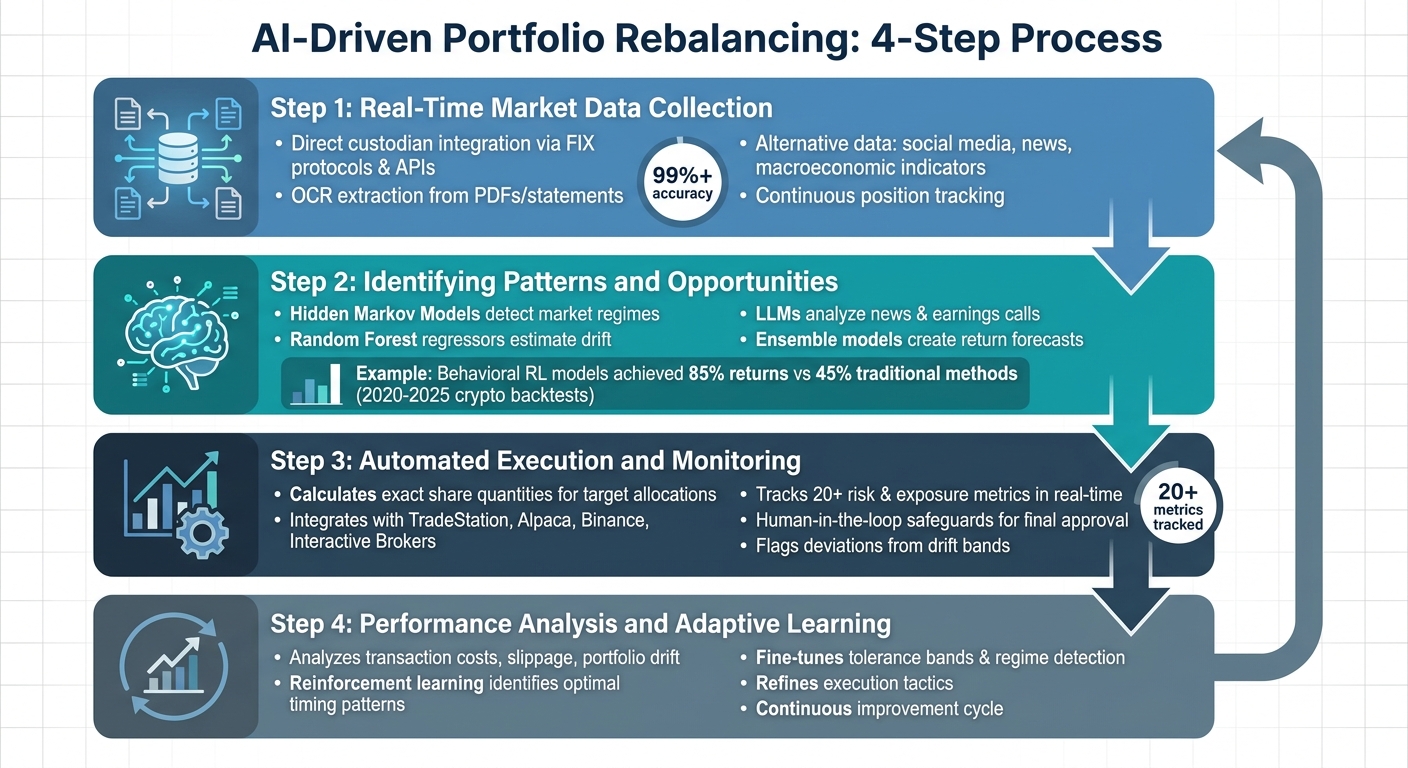
4-Step AI-Driven Portfolio Rebalancing Process
AI-driven portfolio rebalancing turns raw market data into actionable trading decisions. Each step builds on the last, creating a cycle of data gathering, analysis, execution, and improvement.
Real-Time Market Data Collection
AI systems gather data from various sources simultaneously, ensuring an up-to-the-minute view of your portfolio. Using direct custodian integration through FIX protocols, APIs, or flat-file transfers, these systems track position data in real time. When direct connections aren’t an option, AI utilizes Optical Character Recognition (OCR) to extract data from PDFs, images, or CSV brokerage statements with over 99% accuracy . Beyond standard financial data, AI incorporates alternative sources like social media sentiment, news updates, and macroeconomic indicators, enriching its risk assessment framework. This real-time data is essential for spotting emerging trends and opportunities.
Identifying Patterns and Opportunities
After collecting data, AI dives into analysis to identify rebalancing opportunities. Hidden Markov Models (HMMs) detect market regimes, while Random Forest regressors estimate expected drift using factors such as realized volatility, trading volume, and bid-ask spreads. Large Language Models analyze unstructured data, like news and earnings calls, to assess event probabilities - positive or negative - that could prompt rebalancing. Ensemble models then create return forecasts, which optimizers use to calculate the most effective target weights. For example, cryptocurrency backtests from 2020 to 2025 showed that behavioral reinforcement learning models achieved 85% cumulative returns, outperforming traditional threshold methods, which yielded 45%. These insights flow directly into automated execution and ongoing portfolio oversight.
Automated Execution and Monitoring
Based on the analyzed data, AI calculates the exact number of shares needed to meet target allocations, reducing the risk of manual errors. The system integrates with major trading platforms like TradeStation, Alpaca, Binance, and Interactive Brokers, enabling both single-click and fully automated order execution . It also tracks over 20 risk and exposure metrics in real time, flagging deviations from drift bands. Many platforms include human-in-the-loop safeguards: the AI prepares trades and sends notifications for final approval before execution.
Austin Starks, Founder of NexusTrade, explains: "The platform incorporates additional safeguards for live trading to ensure you have the final say. For your financial safety, the system sends an alert with the trades 100% ready for execution. All it needs is our final approval".
Performance Analysis and Adaptive Learning
Once trades are executed, AI evaluates their outcomes to refine its strategies. It measures the effectiveness of rebalancing actions by analyzing transaction costs, slippage, and portfolio drift. Reinforcement learning models identify optimal timing patterns based on historical trends like mean-reversion or momentum. Using this feedback, the AI fine-tunes its tolerance bands, regime detection settings, and execution tactics, creating a continuous cycle of improvement.
Advantages for MQL5 Traders
MQL5 traders benefit from cutting-edge AI processes that significantly improve portfolio automation and trading performance. These advancements provide clear operational and strategic gains.
Higher Precision in Automated Trading
AI takes MetaTrader 5 portfolio automation to the next level by replacing rigid rules with dynamic decision-making. Instead of relying on static thresholds like a fixed ±5% drift limit, AI uses Random Forest regressors to create flexible tolerance bands that adjust based on real-time factors like volatility and trading volume. This allows your Expert Advisor to fine-tune its sensitivity - tightening controls in volatile markets and relaxing them when conditions are stable.
Hidden Markov Models add another layer of sophistication by identifying market regimes in real time, such as Bull, Sideways, or Bear Volatility states. This enables your MQL5 bot to adjust its rebalancing frequency, increasing activity during turbulent periods and scaling back when markets calm down. The result? Smarter, more efficient trading that balances performance with cost. Backtests have consistently shown that these AI-driven metrics deliver measurable improvements for MQL5 traders.
Lower Costs and Fewer Human Errors
AI also cuts down on manual trading costs and reduces errors. Managing multiple positions manually often leads to mistakes in calculations or missed opportunities. AI automates these complex processes, ensuring precise execution across numerous trades - something manual trading simply can't replicate consistently.
Austin Starks, Founder of NexusTrade, says: "In comparison to executing dozens of manual trades, the difference [with AI] is legitimately night and day".
Additionally, AI-driven liquidity models forecast market impact and bid-ask spreads, optimizing trade execution through VWAP windows. This reduces the frictional costs that often eat into rebalancing gains. AI also eliminates emotional biases, such as holding onto losing positions or delaying necessary trades, by relying on data-driven decisions.
Better Risk Management
AI's adaptive tools also enhance risk management for MQL5 portfolios. It continuously monitors risk factors, ensuring allocations align with target levels. Variational Autoencoders simulate thousands of Monte Carlo scenarios to keep portfolios within Value-at-Risk (VaR) thresholds, integrating tail-risk adjustments directly into the rebalancing process. This approach has proven effective, reducing maximum drawdowns to about 35% in AI-driven strategies, compared to 48% in traditional quarterly methods.
Large Language Models further refine risk management by analyzing unstructured data, such as news and earnings reports, and triggering rebalancing based on sentiment polarity - often before price changes take full effect. Neural primal-dual frameworks also ensure compliance with risk, liquidity, and tax constraints in real time. For MQL5 traders, this means your Expert Advisor adapts seamlessly to market shifts, maintaining your risk profile - even during overnight sessions when you’re not actively monitoring trades.
Using Traidies to Implement AI-Powered Rebalancing
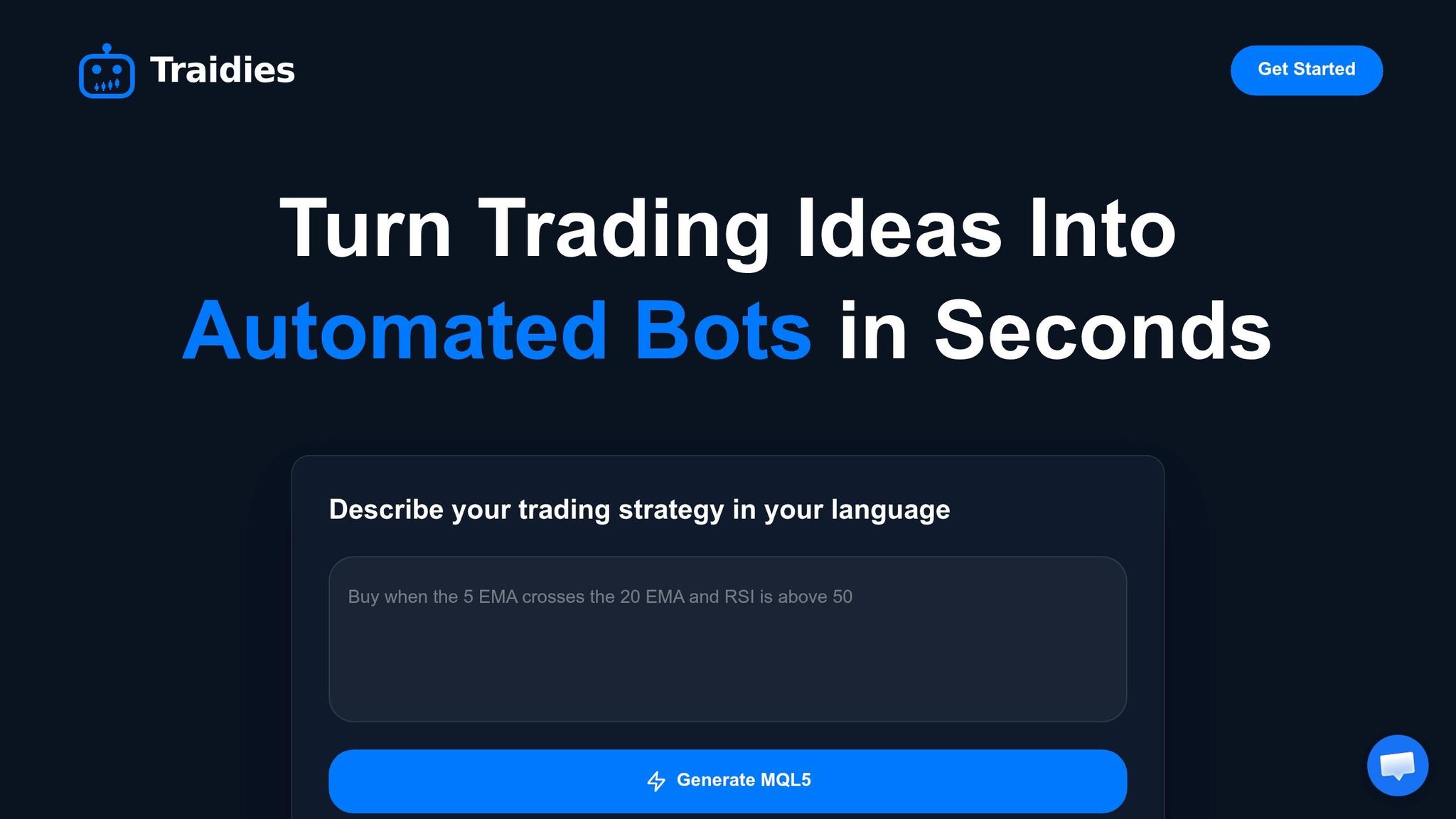
Traidies takes advanced AI-driven rebalancing strategies and makes them practical for MQL5 traders. By bridging the gap between complex portfolio management techniques and user-friendly tools, it enables traders to automate their strategies without needing extensive programming expertise.
Simplifying Strategy Creation with AI
With Traidies, creating a trading strategy is as simple as describing it in plain English. Thanks to its use of Large Language Models, the platform can interpret natural language instructions and turn them into actionable strategies. For example, you might specify: "Rebalance when any asset drifts over 5%." The AI Strategy Parser takes this input and generates a detailed portfolio plan, complete with buy/sell rules and alert conditions. These can be based on metrics like changes in P/E ratios or shifts in market sentiment.
Generating MQL5 Code for Expert Advisors
Once your strategy is defined, Traidies converts it into fully functional MQL5 code for MetaTrader 5. This seamless process removes the need to learn the intricacies of MQL5 programming. The result? Customizable Expert Advisors that accurately execute your rebalancing strategy, tailored to your needs.
Automated Backtesting for Strategy Validation
Before deploying your strategy, Traidies offers an automated backtesting feature to ensure it performs as expected. By simulating historical market conditions, you can refine key parameters like drift thresholds. For instance, test whether a 3% rebalancing band offers better results than a 5% band by weighing tracking accuracy against transaction costs. This step ensures your strategy is optimized and ready for live trading.
24/7 Live Portfolio Management
After validation, your AI-powered strategy goes live on MetaTrader 5. Traidies automates everything - from real-time monitoring to trade execution - ensuring your portfolio is managed efficiently, even during overnight trading sessions.
Conclusion
AI has reshaped the way traders handle portfolio rebalancing by replacing rigid schedules and manual number-crunching with real-time monitoring, uncovering hidden risks across multiple accounts, and executing trades with precision. Every step in the AI-driven process - data gathering, analysis, and adaptive learning - contributes to this shift. Dynamic rebalancing ensures portfolios react to actual market movements rather than sticking to fixed timelines.
The numbers back this up. Threshold-based rebalancing can lower portfolio volatility by 15–20%, while systematic rebalancing adds an average annual premium of 0.2–0.5%. Tax-aware strategies can further boost returns by 1–1.5% annually.
"Embedding AI across the portfolio rebalancing workflow - from adaptive trigger mechanisms and regime‑aware timing to ensemble‑enhanced optimizers and sophisticated cost modeling - enables superior risk‑adjusted performance." - Moolah Capital
While manual traders often face emotional biases and calculation errors, AI systems operate around the clock, handling both the math and the monitoring seamlessly. Tools like Traidies make it easier to adopt AI by converting plain English strategies into MQL5 code, enabling automated backtesting while keeping execution fully under the trader’s control.
With these advancements, the future of portfolio management is already unfolding. As markets continue to evolve, traders leveraging AI-driven automation will manage portfolios that are not only larger but also more efficient. The tools are available, and the results are clear - this is the time to integrate AI into your trading strategy.
FAQs
How does AI decide when to rebalance?
AI relies on dynamic, data-driven triggers to determine the right moments for rebalancing. It evaluates real-time market metrics like price fluctuations, volatility, and trading volume to make informed decisions. By incorporating advanced methods like reinforcement learning, these systems can assess market conditions and refine their timing strategies over time. This allows for rebalancing that is both timely and cost-efficient, sidestepping the rigidity of fixed schedules or static thresholds while staying responsive to shifting market dynamics.
What data does AI use for rebalancing signals?
AI-powered systems continuously evaluate real-time portfolio data, such as current asset weights and any shifts from target allocations. They also factor in market data - like asset prices, trading volumes, and trends - to pinpoint opportunities for rebalancing. Some advanced platforms go a step further, using behavioral insights, predictive analytics, and client-specific information to customize decisions. By keeping an eye on these variables, AI ensures portfolios stay aligned with target allocations while fine-tuning risk and return in real time.
Can Traidies turn my rebalancing rules into an MQL5 bot?
Traidies makes it possible to turn your rebalancing rules into an MQL5 bot. With its AI-driven tools, you can describe your trading strategies in plain language, generate MQL5 code, and even backtest them using historical data. This streamlines the process of automating your portfolio rebalancing strategies, saving time and effort.