Modular Design for Algorithmic Trading: Basics

Modular Design for Algorithmic Trading: Basics
Building a trading system can be overwhelming, but modular design simplifies the process. Instead of one massive codebase, modular systems break down tasks into smaller, independent components. This approach improves maintenance, testing, and scalability. Key modules include data management, strategy development, execution, and performance analysis. Each module focuses on a specific function, making it easier to debug, update, and reuse code across multiple systems. Tools like Python and MQL5 can help implement this structure effectively. By organizing your system into layers and following principles like separation of concerns, you can create a more efficient and reliable trading platform.
Beyond Strategies : Deep Dive into building an Algorithmic Trading System on AWS Cloud
sbb-itb-3b27815
Core Components of a Modular Trading System
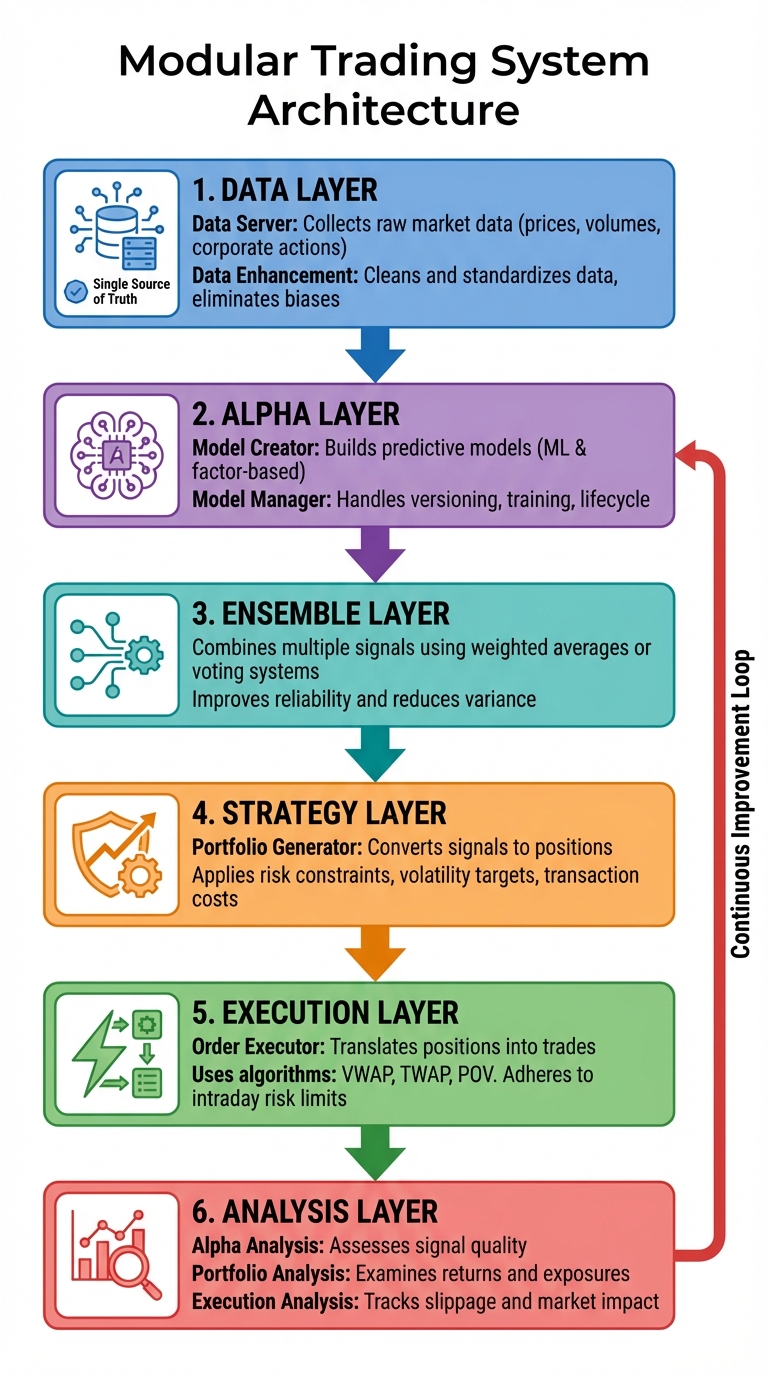
Modular Trading System Architecture: 6 Core Layers
A modular trading system is like a well-oiled machine, with each part handling a specific task in the trading process. Picture it as market data flowing through a series of stages, eventually leading to executed trades. These distinct modules not only simplify the system but also make it easier to test, scale, and maintain. Key layers include data management, alpha generation, portfolio construction, execution, and analysis.
Data Acquisition and Management Modules
At the heart of the system lies the Data Server, which collects raw market data - such as prices, trading volumes, and corporate actions - from various sources and consolidates it into a single repository. This consolidated data acts as the system's "single source of truth", ensuring consistency across all modules.
Next comes the Data Enhancement module, which cleans and standardizes the raw data. This process includes adjustments to eliminate survivorship and look-ahead biases, ensuring the data is reliable and free of distortions before being passed along. These steps are essential for maintaining reproducibility and preventing errors caused by data leakage.
Strategy Development and Testing Modules
Once the data is cleaned and organized, the focus shifts to creating and testing trading strategies. The Model Creator is where predictive models take shape - whether you're using machine learning techniques or traditional factor-based approaches. Meanwhile, the Model Manager oversees tasks like versioning, training schedules, and lifecycle management, keeping things organized and efficient.
This modular setup allows researchers to experiment with new ideas without disrupting the live trading system. The Ensemble Layer further refines the process by combining multiple signals - using methods like weighted averages or voting systems - to improve reliability and reduce variance. Many professional quant funds rely on tools like these to innovate without having to overhaul their entire system.
Execution and Risk Management Modules
When it's time to act on the generated signals, the Portfolio Generator steps in. This module converts alpha signals into actionable investment positions, solving optimization problems while considering factors like risk constraints, volatility targets, and transaction costs.
The Order Executor takes it from there, translating portfolio positions into actual trades. It uses algorithms such as VWAP, TWAP, or POV to execute orders while adhering to intraday risk limits. These modules - Strategy, Portfolio, Risk Management, and Execution - are foundational, forming the backbone of most trading algorithms.
Finally, the Analysis Layer evaluates the system's performance. It includes modules for alpha analysis (assessing signal quality), portfolio analysis (examining returns and exposures), and execution analysis (tracking slippage and market impact).
A Feedback Loop ties everything together, feeding post-trade insights back into the system. This loop helps refine models and parameters over time, ensuring continuous improvement - a hallmark of modular trading systems.
Design Principles for Modular Trading Systems
Modular trading systems thrive on design principles that promote clarity, scalability, and seamless interaction between components. Once the core modules are in place, applying these principles ensures they perform reliably and adapt to evolving demands.
Separation of Concerns
Every module should focus on a single, well-defined function. For instance, a data management module should only handle acquiring and cleaning market data, while execution modules focus on placing trades, and strategy logic generates alpha signals. Keeping these roles separate minimizes the risk of unintended side effects when changes are made. Clemence Benjamin, an MQL5 Developer, explains:
"Modularization... allows developers to encapsulate specific functionalities into modules or classes... code becomes more manageable, easier to maintain, and less error-prone since changes to one module don't necessarily impact others".
This approach ensures independence across modules. For example, you can test a new trade execution algorithm without altering the core strategy logic. Centralizing communication further enhances this structure. Instead of modules interacting directly, all data flows through a single handler - like the OnTick function in MQL5 - preventing tangled dependencies and keeping the architecture straightforward.
By maintaining clear boundaries, you naturally pave the way for modules that are both adaptable and reusable.
Reusability and Scalability
A well-designed module should function seamlessly across different strategies. Features like a trailing stop, a news filter, or a position sizing calculator should integrate effortlessly whether you're running a trend-following or a mean-reversion system. To achieve this flexibility, design modules with parameter inputs - like API credentials or risk thresholds - and leverage object-oriented programming (OOP) techniques, such as base classes and external headers (.mqh), for a clean and reusable codebase.
For instance, a strategy base class with interchangeable decision-making logic allows you to switch from one trading approach to another without rebuilding the entire system.
Scalability, on the other hand, comes from maintaining a static workflow for data ingestion and processing. This ensures stability and auditability while keeping modeling and execution logic flexible for rapid updates. Such a structure allows your system to handle larger data volumes and more complex strategies without requiring an overhaul.
With reusability and scalability in place, the next step is ensuring the system is easy to test and debug.
Testing and Debugging in Modular Systems
One of the biggest advantages of modular systems is the ability to test and debug individual components in isolation. When issues arise, you can zero in on the problematic module, avoiding the need to comb through thousands of lines of code.
To maintain system stability, initialize modules in OnInit, execute logic in OnTick, and release resources in OnDeinit to prevent memory leaks. Use clear return codes, such as +1 for success (SUCCEEDED_CODE) and -1 for failure (FAILED_CODE), to handle function outcomes cleanly.
For easier troubleshooting, consider adding a GetName() method to each module so it can log its name during errors. Breaking down monolithic scripts into smaller, independent modules also makes unit and integration testing more manageable, saving significant time during debugging. This modular approach not only simplifies problem-solving but also enhances overall system reliability.
How to Implement Modular Design
Choosing the Right Tools and Platforms
Select tools that encourage modularity and reusability. A great combination is Python for research and machine learning, paired with MQL5 for live trade execution. Python's libraries - like Pandas, NumPy, and Matplotlib - are perfect for model development and testing. Meanwhile, MQL5 integrates seamlessly with MetaTrader 5, handling tasks like order management.
When working with MQL5, use Object-Oriented Programming (OOP) and .mqh include files to separate components like the user interface, trading logic, and utility functions. This approach keeps your trading logic clean and allows you to update individual parts without disrupting the rest of the system.
If you want to avoid diving deep into code, platforms like Traidies can simplify things. They convert natural language strategy descriptions into MQL5 code and automate backtesting using historical data. This lets you focus on refining strategies while the platform takes care of coding and testing.
By leveraging these tools, you can lay the foundation for a well-organized modular system.
Creating a Modular Architecture
Structure your trading system into distinct layers, each responsible for a specific function. Here's a breakdown:
- Data Layer: Aggregates and cleans market data.
- Alpha Layer: Hosts predictive models that generate trading signals.
- Ensemble Layer: Combines models using methods like weighted averages or voting.
- Strategy Layer: Applies risk constraints, such as volatility limits and drawdown thresholds.
- Execution Layer: Converts positions into trades using algorithms like VWAP or TWAP.
- Analysis Layer: Evaluates alpha quality, portfolio performance, and execution efficiency.
This layered approach ensures tasks are clearly separated, making the system easier to test and scale.
To minimize dependencies between modules, route all data through a central handler. This "conductor" ensures that a failure in one module won’t disrupt the entire system. Use a central management class - such as a ModelManager or MarketMaker - to coordinate independent modules like volume analysis, risk control, and signal generation.
Iterative Development and Continuous Improvement
Once your modular architecture is in place, iterative development ensures it adapts to changing market conditions. Use closed-loop feedback to guide model retraining and system updates. For example, post-trade analysis can inform adjustments to ensemble weights or portfolio constraints, creating a system that evolves over time. As quantitative researcher Hiya Chatterjee explains:
"Modern quantitative trading systems are no longer monolithic pipelines that move linearly from data to execution. Instead, they are modular, feedback-driven, and dynamically configurable platforms."
Design modules for flexibility. For instance, a basic trading scheduler should be swappable for a more advanced version without changing the core logic. A model manager can simplify tasks like versioning, training, and parameter updates, making it easier to roll back changes if performance declines. Implement asynchronous execution to monitor multiple instruments at once, avoiding bottlenecks as your system grows.
Replace fixed parameters with dynamic adjustments based on market conditions. For example, use a volatility factor to modify risk controls instead of relying on static stop-loss levels. When calculating statistical indicators, consider using logarithmic returns instead of simple percentage changes for greater stability. Finally, integrate a partial closing mechanism to lock in 50% of profits at predefined thresholds, helping improve overall performance metrics.
Conclusion
Benefits of Modular Design
Let’s bring everything together and focus on why modular design is such a game-changer for algorithmic trading systems. Instead of wrestling with a massive, tangled codebase, modular design breaks everything down into independent, self-contained components that communicate through clear, defined interfaces. This structure makes it easier to swap out an alpha module or update your risk management logic without touching the rest of the system. And when bugs inevitably crop up? You can zero in on the specific module causing the issue instead of sifting through thousands of lines of code.
The efficiency perks are hard to ignore. Code reusability means you only need to write a trailing stop function or news filter once, and then you can plug it into multiple systems with minimal adjustments. Teams see big collaboration boosts, too, as developers can work on separate modules simultaneously. Plus, as your trading needs grow, adding features - like AI-driven signal checks or advanced backtesting tools - becomes far simpler because you’re not starting from scratch.
| Benefit | Impact on Your Trading System |
|---|---|
| Flexibility | Quickly swap modules to adapt to shifting market conditions |
| Maintainability | Update specific components without risking system-wide issues |
| Reusability | Save time by reusing tested code blocks across multiple systems |
| Scalability | Seamlessly add features like AI or enhanced GUIs as you expand |
| Reliability | Isolated testing catches bugs early, before they hit production |
These advantages create a solid framework for improving both the performance and manageability of your trading systems.
Next Steps for Traders
Now that you understand the benefits, it’s time to take action. Start small. Look for one repetitive task in your current system - maybe position sizing or notification handling - and turn it into a standalone function or class. Use header guards to avoid duplicate compilation errors, and make sure your user interface is separate from your trading logic to keep everything clean and organized.
For those using MQL5 but hoping to simplify the coding process, tools like Traidies can be a lifesaver. It converts natural language descriptions of strategies into executable code and even handles automated backtesting for you. This makes adopting modular principles much easier, even if coding isn’t your strong suit. The key is to standardize your module interfaces so you can add, remove, or replace components effortlessly as your system evolves.
FAQs
What’s the best first module to build in a modular trading system?
When choosing your first module, there’s no one-size-fits-all answer. However, it’s crucial to begin by establishing a solid foundation for your system. Start by designing an architecture that’s built to grow and evolve. By prioritizing this step before adding interactions between components, you can ensure your system stays flexible and ready to scale as new features are added.
How do modules communicate without creating tangled dependencies?
Modules in algorithmic trading systems are designed to work together through streamlined interfaces and a clear division of responsibilities. Each module focuses on specific tasks, communicating through structured channels like APIs or event-driven messaging systems. This approach minimizes tightly linked dependencies, making the system easier to maintain, expand, and adapt. It also allows individual components to be updated or improved without causing disruptions to the overall architecture.
How do I test each module before running it live?
You can use the MetaTrader 5 Strategy Tester to test each module. This tool allows you to debug programs in different modes, whether you're working with real ticks or modeled ones. It also offers a feature to visualize the price stream, making it easier to observe market movements. Additionally, the tester helps assess financial performance and fine-tune trading strategies. For a deeper analysis, the visualizer can be used to study patterns and results in greater detail.