Modular MQL5 Systems: Performance Optimization

Modular MQL5 Systems: Performance Optimization
To build a high-performing MQL5 trading system, break your Expert Advisor (EA) into modular components like signal generation, trade execution, and risk management. This approach improves reliability, simplifies debugging, and allows for easy integration of new features like AI filters. Optimizing performance is critical - poorly optimized systems can miss trades or crash during high volatility. Key strategies include:
- Efficient Processing: Use new-bar detection and timers to reduce unnecessary calculations.
- Memory Management: Preallocate arrays and manage indicator handles properly.
- Object-Oriented Design: Use classes and interfaces for reusable, maintainable code.
- Backtesting and Monitoring: Validate performance with robust testing and real-time diagnostics.
Fast EA optimization using MQL5 Cloud Network

sbb-itb-3b27815
Designing Efficient Modular Architectures
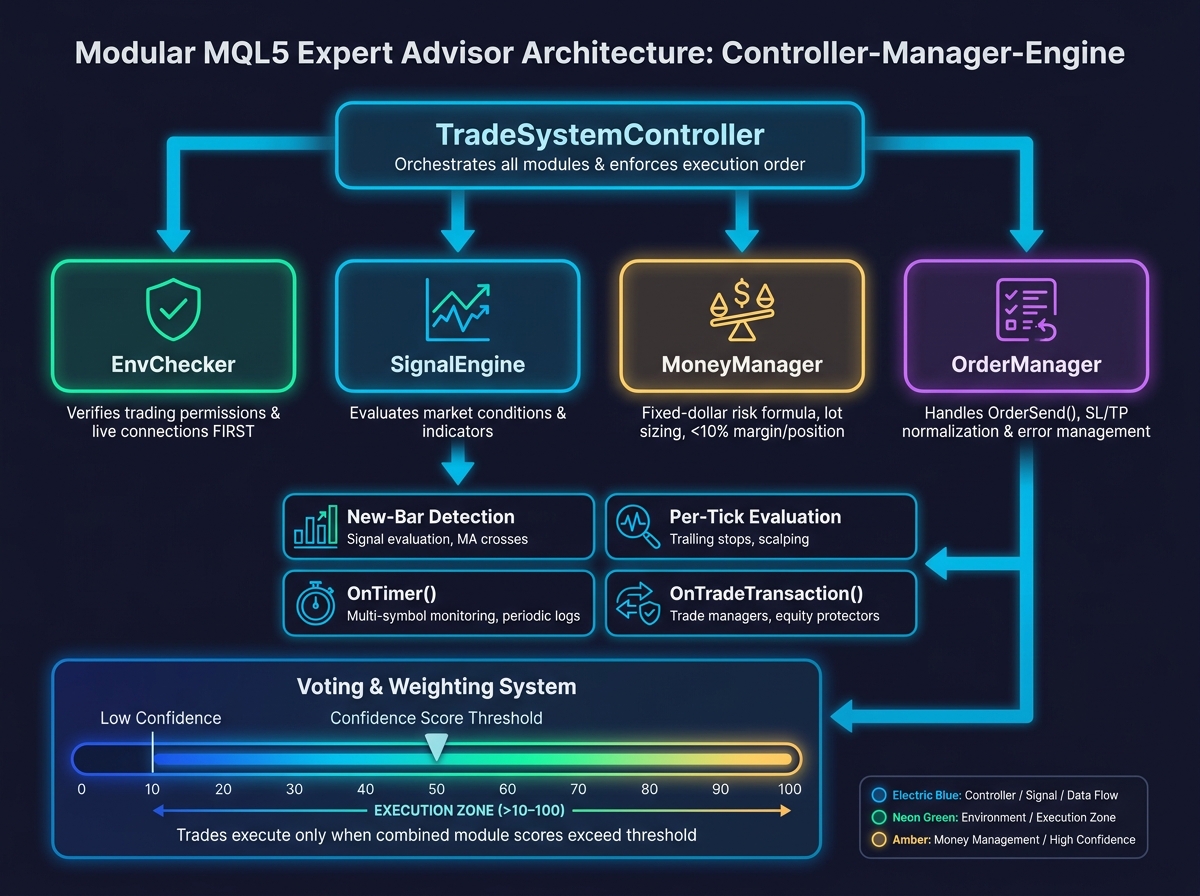
Modular MQL5 EA Architecture: Controller-Manager-Engine Pattern
Key Architectural Patterns
Creating efficient MQL5 systems starts with a clear separation between decision-making and execution. The decision layer is responsible for evaluating market conditions, monitoring indicators, and applying session filters. Meanwhile, the execution layer focuses on tasks like handling OrderSend() calls, normalizing stop-loss and take-profit levels, and managing errors. Keeping these layers distinct avoids the messy, tangled conditions that can make debugging a nightmare.
"Most MT5 EAs fail for the same reason: they are built like experiments, not systems. Random logic, tangled conditions, indicator calls everywhere, and no separation between decision-making and execution." - Keisuke Kurosawa
One effective approach is the Controller-Manager-Engine pattern, which assigns specific roles to each module. For example, a central TradeSystemController oversees specialized components like MoneyManager, OrderManager, SignalEngine, and EnvChecker. The EnvChecker module ensures that runtime conditions - such as trading permissions and live connections - are verified before any other logic runs. This prevents bugs in one module from disrupting the entire system.
For strategies that rely on multiple signals, a voting and weighting system can add an extra layer of control. Each module assigns a confidence score (ranging from 0 to 100), and trades are executed only when the combined score exceeds a predefined threshold, typically between 10 and 100. This ensures decisions are based on consensus rather than a single unreliable signal.
"The beauty of the MQL5 Standard Library is that it allows us to plug these modules into a central EA, which acts as the portfolio manager." - Clemence Benjamin
This modular design not only streamlines debugging but also creates a solid foundation for managing data flow.
Data Flow and Event-Driven Design
Optimizing how and when tasks are executed is critical for performance. Not every operation needs to run on every tick. Dividing tasks by frequency - such as every tick, at the start of a new bar, at fixed intervals, or during specific transactions - can significantly reduce unnecessary CPU usage.
For signal-based strategies, new-bar detection is a highly efficient method. By storing the last processed bar's time in a static variable and using iTime() to detect new bars, you can trigger resource-intensive operations only when needed. This simple adjustment can eliminate hundreds of redundant calculations every minute.
"Why check your logic multiple times a second when you only care about the state of a new bar once an hour? The
OnTimer()event handler solves this problem." - Michael Prescott Burney, MQL5 Developer
For immediate responses to trade-related events, the OnTradeTransaction() event is invaluable. This handler activates whenever an account event occurs, such as a broker-side execution or a manual trade, allowing for real-time updates without waiting for the next price tick. It’s an ideal solution for trade managers and equity protectors.
Here’s a quick overview of when to use specific processing patterns:
| Processing Pattern | Best Use Case |
|---|---|
| New-bar detection | Signal evaluation, moving average crosses, closed-bar filters |
| Per-tick evaluation | Trailing stops, scalping, sudden price-change monitoring |
OnTimer() |
Multi-symbol monitoring, periodic log updates, higher timeframe EAs |
OnTradeTransaction() |
Trade managers, equity protectors, trade copiers |
Object-Oriented Design in MQL5

Efficient modular systems benefit greatly from object-oriented programming (OOP). MQL5's OOP features - like classes, inheritance, and polymorphism - allow developers to create reusable and maintainable code. Abstract classes and interfaces, for instance, can define module contracts. An abstract CTradeSystemController class can outline rules for all controller implementations, while an ISignalEngine interface ensures that all signal modules follow the same structure, regardless of their internal logic.
Leveraging the MQL5 Standard Library is another time-saver. Built-in classes like CExpertSignal provide ready-made infrastructure for risk management and trade execution, so you can focus on developing your unique strategy logic without reinventing the wheel.
Write your code as a reusable library rather than a one-off script. Wrapping low-level functions like OrderSend() into high-level methods - such as OpenOrder() or Exit() - keeps the main EA file clean and easier to read. As MQL4Solutions puts it:
"The closer your code is to the natural language of high-level requirements, the more efficient and accountable your code is." - MQL4Solutions
Finally, keep user interface components - like dashboards, popups, and scrollbars - separate from core trading logic by placing them in dedicated .mqh include files. This makes the codebase easier to maintain and scale as your system evolves.
Optimizing Computational Efficiency
Boosting computational efficiency is a key step in improving the performance of modular systems. Let’s break down some practical techniques to achieve this.
Efficient Data Access and Indicator Calculations
Slow data access can bog down MQL5 Expert Advisors. A common mistake is using functions like iClose() or iOpen() in loops. Instead, you can use CopyBuffer() to fetch multiple values in one go. As Alain Verleyen, an MQL5 moderator, explains:
"Using iClose/iOpen candle by candle? These functions are the slowest to deal with data."
To avoid performance issues, initialize indicator handles in the OnInit() function and release them in OnDeinit(). This approach keeps the OnTick() function running smoothly. Additionally, always check that CopyBuffer() retrieves the expected number of elements before processing to sidestep potential bugs.
For custom indicators, leverage the prev_calculated parameter in the OnCalculate() function. This allows you to skip over bars that have already been processed, ensuring that only new data is handled.
Once data access is optimized, the next focus should be on refining loops and managing memory effectively.
Optimizing Loops and Memory Usage
Memory management often becomes a hidden challenge in modular systems. Mismanagement of dynamic arrays, strings, and class objects can lead to inefficiencies. For example, frequent calls to ArrayResize() in the OnTick() function can cause unnecessary memory allocation overhead. Instead, preallocate arrays to minimize these costly operations.
"Many developers focus solely on strategy logic... while memory handling quietly becomes a ticking time bomb in the background." - Advanced Memory Management and Optimization Techniques in MQL5, MQL5 Articles
When working with loops, exit them as soon as conditions are met to save CPU cycles. In multi-symbol systems, you can use a modulo-based processing counter (e.g., tickCounter % TotalPairs) to ensure that only one symbol is processed per tick. This technique prevents CPU spikes during busy market periods.
For tasks that involve frequent object creation, such as generating trade signals, a memory pool can be a game-changer. By pre-allocating a batch of objects, you reduce the overhead caused by constant heap allocation and deallocation.
Using Timers for Load Distribution
Timers are another tool to spread out processing tasks, helping to reduce the load on OnTick() and improve overall efficiency. Tasks like updating dashboards, monitoring spreads, checking account equity, or scanning multiple symbols don’t need to run on every price tick. These can be offloaded to the OnTimer() function.
"By using OnTimer(), this EA is far more efficient. It only consumes CPU resources once a minute, leaving your terminal more responsive and reducing the processing load." - Michael Prescott Burney
Set up timers in OnInit() and ensure they are properly terminated in OnDeinit() to avoid memory leaks. For instance, the Horizon5 framework uses a 1-second timer to coordinate periodic events like OnStartMinute, OnStartHour, and OnStartDay. This approach transforms MT5’s single-threaded tick loop into a well-coordinated, multi-asset system without overloading the main trading thread.
Another benefit of MQL5 timers is their built-in safeguard: if a timer event is still being processed when the next one is triggered, the new event is skipped. This prevents a backlog of calculations.
When using both OnTick() and OnTimer(), ensure they don’t simultaneously modify the same global variables. Overlapping updates can introduce subtle bugs in modular systems.
Scalability and Long-Term Performance
Efficient computation is just the starting point. Achieving scalability and stability over time requires carefully designed strategies for handling multiple symbols, timeframes, and resource constraints.
Multi-Symbol and Multi-Timeframe Strategies
When scaling a modular MQL5 system across multiple symbols and timeframes, organization is key. A two-dimensional array - using symbols and timeframes as indices (e.g., symbolAvrSeriesLength[s][t]) - helps streamline data management, eliminating the need for separate arrays per instrument.
For signal generation, the Observer design pattern can simplify the process. By decoupling market analysis from trade execution, observer classes can translate complex indicators into a standardized "Signal Pulse" ranging from -1.0 to 1.0. This makes it easier to aggregate signals for consensus-based trading decisions. In some advanced implementations, this method has achieved signal propagation times under 800 milliseconds between analysis and execution.
Running multi-timeframe strategies adds another layer of complexity. To ensure no signals are missed, the system should use the lowest active timeframe as the reference for the "new bar" check loop. This approach keeps signals synchronized across higher timeframes while maintaining consistent timing.
Resource Management and Concurrency
MQL5’s threading model has a critical limitation: all indicators on a single symbol share one thread. If an indicator gets stuck in an infinite loop, it blocks all other events for that symbol. As the MQL5 documentation explains:
"If an infinite action is performed in an indicator, all other events associated with its symbol will never be performed."
To mitigate this, isolate heavy computations within Expert Advisors (EAs) rather than indicators. Since each EA operates in its own thread, this approach minimizes the risk of bottlenecks. For systems trading across five or more symbols, a modulo-based symbol switching technique - processing one symbol per tick - can help manage CPU usage without compromising market coverage.
Risk management is equally important. Use a fixed-dollar risk formula and apply MathFloor to ensure lot sizes align with risk budgets. Additionally, keeping margin usage below 10% per position reduces the likelihood of margin calls when trading multiple pairs. These practices, combined with earlier performance optimizations, ensure the system can handle diverse market conditions smoothly.
Keeping Long-Running Systems Stable
Stability over extended periods requires proactive measures to prevent system degradation.
Long-running systems can suffer from issues like memory leaks, handle accumulation, or stale states. To avoid this, always call IndicatorRelease() in the OnDeinit() function to free up resources and prevent memory bloat. Serializing the system state (e.g., using JSON) allows the EA to resume its exact logical position after a terminal restart or VPS reboot.
Independent module design further strengthens resilience. This way, if one component fails, it doesn’t jeopardize the entire system. Automated housekeeping routines, such as forward-filling missing ticks or flagging outliers using z-score analysis, help maintain data integrity during extended runs. Adding cooldown periods between trades and disabling symbols temporarily during high-spread conditions can also stabilize operations during low-liquidity periods.
Testing and Monitoring Modular Systems
Backtesting for Performance Validation
Backtesting ensures that every module operates correctly under realistic conditions. To achieve this, choose a testing mode that provides accurate broker tick data. For the highest precision, use the "Every Tick Based on Real Ticks" mode. Though slower, it’s ideal for final validation before deploying your system. In earlier development phases, "Every Tick (Synthetic)" strikes a good balance between speed and accuracy.
A common pitfall in backtesting is path dependency - the risk that a single historical run might appear successful by sheer chance. To address this, Monte Carlo simulations can be used to randomize trade sequences and reveal a broader range of outcomes. For instance, one trend-following EA with a profit factor of 1.6 was found to have a 12% chance of triggering a margin call when trade sequences were randomized.
To ensure consistency between backtesting and live trading, evaluate signals on closed bars (index 1 instead of index 0). This avoids issues like signal repainting and ensures your system behaves consistently across environments. When fine-tuning parameters, avoid locking in a single "optimal" value. Instead, aim for stable performance across a range of nearby values - this is a more reliable indicator of robustness.
| Metric | Target | Purpose |
|---|---|---|
| Profit Factor | > 1.5 | Gross Profit / Gross Loss |
| Sharpe Ratio | > 1.0 | Risk-adjusted return |
| Recovery Factor | > 2.0 | Net Profit / Max Drawdown |
| Stress Drawdown (95th Pct) | 1.5–2.5x Backtest DD | Drawdown exceeded in only 5% of Monte Carlo runs |
Use a split-period approach for testing, dividing historical data into three segments: development (building logic), confirmation (refining parameters), and out-of-sample testing (validating reproducibility). A good benchmark is for out-of-sample performance to reach at least 80% of in-sample performance. Additionally, keeping the number of main parameters between 2 and 4 helps minimize the risk of overfitting.
These thorough validation techniques lay the groundwork for effective live monitoring, ensuring your system continues to perform reliably.
Live Monitoring and Logging
After backtesting, live monitoring is crucial to ensure that each module remains efficient and responsive. However, MetaTrader 5’s standard Experts tab can quickly become cluttered when multiple EAs are running, making it hard to isolate logs for individual tools. As noted in the CBEOMonitor documentation:
"The outputs of multiple systems quickly become intermingled, creating clutter and confusion. When several EAs are active, it becomes difficult to isolate logs for one specific tool."
To address this, implement a dedicated monitoring class that displays diagnostics directly on the chart using MQL5’s CCanvas class. This setup can include color-coded severity levels (Info, Success, Warning, Error) and real-time metrics like tick latency and memory usage. By keeping diagnostics specific to each EA, you avoid cluttering the shared terminal log.
Use OnTradeTransaction to track trade events, and maintain an array of handled deal tickets to prevent duplicate processing. For memory efficiency, consider using a circular buffer (via CList) to store recent log messages without letting memory usage grow unchecked.
To maintain responsiveness, offload heavy I/O tasks using a DLL-backed message bus. Additionally, leverage GetMicrosecondCount() to detect execution spikes in specific modules before they escalate into larger issues.
Maintenance and Upgrades
Maintaining system health requires robust version control and thorough regression testing. A Git-based repository, such as MQL5 Algo Forge, offers a full project history, collaborative features, and reliable recovery options if updates cause issues. It’s also a good practice to separate core library code from project-specific code and use relative paths in #include directives (e.g., ../Utils/MTTester.mqh) to ensure portability across directory structures.
When refactoring a module, aim to make isolated changes without disrupting other components. After updates, perform regression tests on historical data to confirm consistent performance. MetaEditor’s built-in profiler can help identify slow functions both before and after changes. Finally, limit logging to only critical errors and significant state changes - excessive Print calls on every tick can add unnecessary strain on your terminal and VPS.
AI-Powered Development with Traidies

Generating Modular MQL5 Code with AI
Once your monitoring and maintenance workflows are in place, you can shift gears and speed up development without sacrificing quality. Traidies simplifies this process by turning plain English descriptions of trading strategies into structured MQL5 code. The generated code aligns with modular architecture patterns, making it easy to integrate with your existing setup. By using low temperature settings (0.1–0.5), the AI ensures outputs adhere to strict JSON schemas, enabling predictable and deterministic execution. This modular design not only streamlines development but also sets the stage for quicker backtesting and optimization.
Faster Backtesting and Optimization
Traidies offers automated backtesting using historical data, cutting down the time it takes to validate new modules. You can run tests directly on the platform, making it easy to review and refine your results.
What sets Traidies apart is its regime-aware behavior. For instance, the system can recognize volatility changes - like a jump from 8.5 to 23 pips - and adjust accordingly by reducing position sizes or pausing trades during unfavorable conditions. This kind of adaptive logic, which is challenging to code manually, is built into the AI's output. Additionally, AI-generated confidence scores (0.0–1.0) are tied to execution parameters, ensuring only high-confidence signals make it to the order execution layer.
While the fast backtesting process ensures performance, combining AI-generated modules with custom code creates a more flexible and reliable system.
Integrating AI-Generated Code with Custom Modules
AI-generated code typically serves as a solid foundation but may not address every edge case in a live trading system. To make the most of it, use the AI output as a starting point and integrate it with your existing module interfaces.
One effective approach is the conductor class architecture. This setup involves a central class - sometimes referred to as a "MarketMaker" class - that coordinates multiple independent modules, such as those handling volume analysis, risk management, and economic forecasting. These modules work together through a shared synchronization system. AI-generated components can be added as individual handlers within this framework, rather than standalone scripts.
For routing, consider a dispatch-driven action system. This method maps stable integer identifiers to specific handlers, such as "Quick Scalp" or "Trend Read". By replacing complex conditional logic with a clean routing layer, you can easily swap or expand AI-generated modules without altering the core system. To ensure reliable communication between modules, restrict AI-generated outputs to structured formats like line-based KEY:VALUE protocols or parsed JSON. This ensures consistent parsing of entry, stop-loss (SL), and take-profit (TP) levels in MQL5 code for seamless automated execution.
Conclusion
Key Takeaways
Keep your modules independent - Signal Engine, Money Manager, Order Manager, and Environment Checker - so that a failure in one doesn't bring down the entire system. As highlighted in MQL5 Article 16667:
"The more independent the modules were, the better the system worked. The failure of one component did not stop the others." – MQL5 Article 16667
Avoid running heavy computations on every tick. Instead, use new-bar events for complex calculations and reserve tick updates for lightweight tasks. For efficient resource management, initialize indicator handles in OnInit, release them in OnDeinit, and call CopyBuffer only when new data becomes available.
To ensure long-term stability, consider implementing crash-safe persistence. Techniques like serializing order states to JSON and using deterministic magic numbers through stable seed-based hashing can help your system recover smoothly after a restart, ensuring no open positions are lost.
These principles provide a strong foundation for structuring and scaling your system effectively.
Next Steps
With these performance and modular strategies in mind, take the following steps to move forward. Begin by organizing your system into a modular structure, such as /Core, /Logic, and /Utils directories, and enforce the "One EA, One Position" rule to minimize potential failures.
To speed up your development process, consider using Traidies. This tool allows you to generate structured MQL5 code from plain-language strategy descriptions, run automated backtests with historical data, and integrate AI-generated modules seamlessly into your architecture. As Keisuke Kurosawa of 1kpips wisely said, "Structure beats ideas. Process beats indicators. And consistency beats luck." Whether you're starting fresh or enhancing an existing system, this approach ensures a practical and scalable path forward.
FAQs
What should run on every tick vs only on a new bar?
In MQL5, the OnTick() function executes with every market tick, making it perfect for handling tasks that demand real-time updates. These include activities like managing trades, processing signals, or performing calculations that need instant attention. However, for tasks such as updating indicators or implementing strategies based on bar closures, it’s more efficient to execute them only when a new bar appears. To achieve this, you can check if the current time aligns with the opening of a new bar. This approach helps minimize unnecessary processing and optimizes performance.
How do I prevent indicator handle leaks and memory bloat?
To prevent indicator handle leaks and memory bloat in MQL5, always release indicator handles using IndicatorRelease() when they are no longer required. After releasing a handle, assign it to INVALID_HANDLE to avoid accidental reuse. Before releasing, double-check that the handle is valid, and ensure no references to it remain afterward. This practice helps maintain efficient memory management and avoids resource-related problems.
How can I scale one EA to multiple symbols without CPU spikes?
To efficiently scale an EA across multiple symbols without causing CPU spikes, focus on processing only new bars rather than every single tick. A function such as UpdateNewBar() can be used to detect new bars and trigger actions only when required.
Additionally, managing resources is crucial. Dynamically resizing arrays and initializing symbol-specific buffers can help optimize memory usage. By adopting this strategy, you can significantly lower CPU usage and ensure smoother performance when working with multiple instruments.